Bryophytes - 1
Related Keywords
Bryophytes
mosses
liverworts
moist shaded areas in the hills
amphibians
can live in soil but are dependent on water for sexual reproduction.
damp, humid and shaded localities.
plant succession
bare rocks/soil
more differentiated
thallus-like
prostrate or erect
substratum
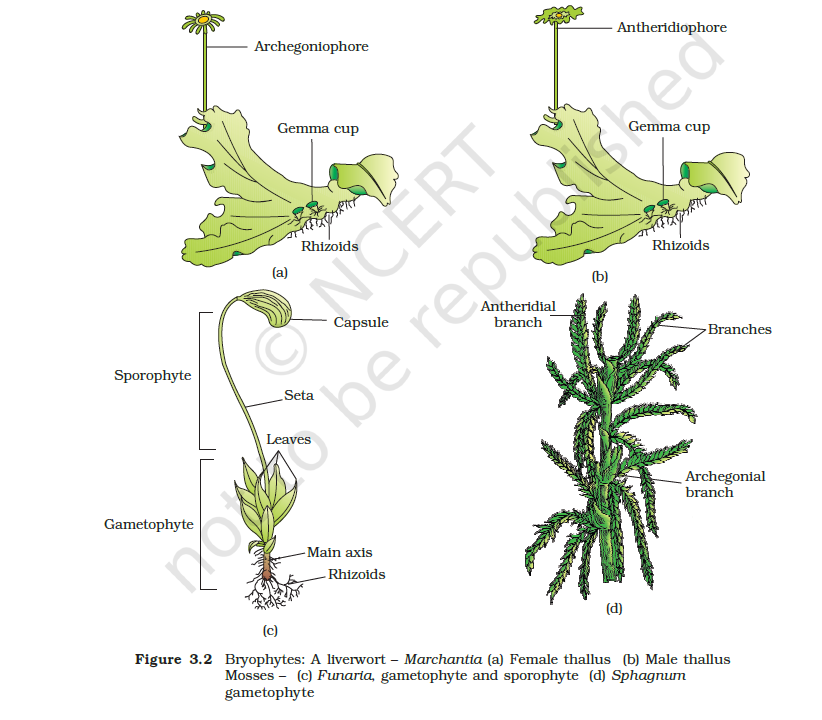
unicellular or multicellular rhizoids
lack true roots, stem or leaves.
root-like, leaf-like or stem-like structures.
haploid
gametes
gametophyte
1
Which of the following correctly describes bryophytes?
Practice
A
Bryophytes include mosses and liverworts commonly found in moist, shaded areas in the hills
B
Bryophytes include brown algae commonly found in deep marine waters
C
Bryophytes include flowering plants commonly found in dry desert regions
D
Bryophytes include ferns commonly found in saline coastal waters
✅ Show Answer
✔ Correct Answer:
A
(Bryophytes include mosses and liverworts commonly found in moist, shaded areas in the hills)
💡 Explanation
Bryophytes: Dictionary meaning — a group of non-vascular plants that includes mosses and liverworts.
Explanation — Bryophytes are small, non-vascular plants that commonly grow in moist and shaded habitats. They include mosses and liverworts and are especially common in moist areas such as hills and forests.
Mosses: Dictionary meaning — small, non-vascular plants that usually grow as dense green mats or cushions.
Explanation — Mosses are common bryophytes that typically grow on moist soil, rocks, tree trunks and other surfaces.
Liverworts: Dictionary meaning — small non-vascular plants belonging to the bryophyte group, often having a flat or leafy body.
Explanation — Liverworts are another major group of bryophytes and commonly occur in moist, shaded environments.
Moist shaded areas: Dictionary meaning — places that have sufficient moisture and receive relatively little direct sunlight.
Explanation — Bryophytes commonly grow in such environments because they require water for reproduction and generally thrive under moist conditions.
Given Statement - Bryophytes include the various mosses and liverworts that are found commonly growing in moist shaded areas in the hills.
Explanation — Bryophytes are small, non-vascular plants that commonly grow in moist and shaded habitats. They include mosses and liverworts and are especially common in moist areas such as hills and forests.
Mosses: Dictionary meaning — small, non-vascular plants that usually grow as dense green mats or cushions.
Explanation — Mosses are common bryophytes that typically grow on moist soil, rocks, tree trunks and other surfaces.
Liverworts: Dictionary meaning — small non-vascular plants belonging to the bryophyte group, often having a flat or leafy body.
Explanation — Liverworts are another major group of bryophytes and commonly occur in moist, shaded environments.
Moist shaded areas: Dictionary meaning — places that have sufficient moisture and receive relatively little direct sunlight.
Explanation — Bryophytes commonly grow in such environments because they require water for reproduction and generally thrive under moist conditions.
Given Statement - Bryophytes include the various mosses and liverworts that are found commonly growing in moist shaded areas in the hills.
🎯 Conclusion
Bryophytes are a group of small, non-vascular plants that mainly include mosses and liverworts. They are commonly found in moist, shaded places, particularly in hilly and forested regions. Their dependence on water for reproduction makes moist habitats especially suitable for their growth and survival.
2
Why are bryophytes called the amphibians of the plant kingdom?
Practice
A
Because they can live only in water and reproduce without water
B
Because they can live in soil but are dependent on water for sexual reproduction
C
Because they can live only in dry soil and require sunlight for reproduction
D
Because they are completely aquatic and depend on air for sexual reproduction
✅ Show Answer
✔ Correct Answer:
B
(Because they can live in soil but are dependent on water for sexual reproduction)
💡 Explanation
Bryophytes: Dictionary meaning — a group of non-vascular plants that includes mosses and liverworts.
Explanation — Bryophytes are called the amphibians of the plant kingdom because they can live on land, usually in moist soil, but require water for sexual reproduction.
Amphibians of the plant kingdom: Dictionary meaning — a term used for bryophytes because they show both terrestrial life and dependence on water for reproduction.
Explanation — Bryophytes generally grow on land but depend on water during sexual reproduction because the male gametes need water to reach the female reproductive structure.
Sexual reproduction: Dictionary meaning — reproduction involving the formation and fusion of male and female gametes.
Explanation — In bryophytes, sexual reproduction requires water because the male gametes are motile and swim through a film of water towards the female reproductive organ.
Water dependence: Dictionary meaning — the requirement of water for carrying out a particular biological process.
Explanation — Although bryophytes are terrestrial plants, water is essential for the movement of their male gametes during fertilisation.
Given Statement - Bryophytes are also called amphibians of the plant kingdom because these plants can live in soil but are dependent on water for sexual reproduction.
Explanation — Bryophytes are called the amphibians of the plant kingdom because they can live on land, usually in moist soil, but require water for sexual reproduction.
Amphibians of the plant kingdom: Dictionary meaning — a term used for bryophytes because they show both terrestrial life and dependence on water for reproduction.
Explanation — Bryophytes generally grow on land but depend on water during sexual reproduction because the male gametes need water to reach the female reproductive structure.
Sexual reproduction: Dictionary meaning — reproduction involving the formation and fusion of male and female gametes.
Explanation — In bryophytes, sexual reproduction requires water because the male gametes are motile and swim through a film of water towards the female reproductive organ.
Water dependence: Dictionary meaning — the requirement of water for carrying out a particular biological process.
Explanation — Although bryophytes are terrestrial plants, water is essential for the movement of their male gametes during fertilisation.
Given Statement - Bryophytes are also called amphibians of the plant kingdom because these plants can live in soil but are dependent on water for sexual reproduction.
🎯 Conclusion
Bryophytes are called the amphibians of the plant kingdom because they live mainly on land, often in moist soil, but still depend on water for sexual reproduction. Water is essential for the movement of their male gametes to the female reproductive structure, allowing fertilisation to occur.
3
In which type of localities do bryophytes usually occur?
Practice
A
Dry, hot and exposed localities
B
Damp, humid and shaded localities
C
Salty, marine and brightly lit localities
D
Cold, dry and desert localities
✅ Show Answer
✔ Correct Answer:
B
(Damp, humid and shaded localities)
💡 Explanation
Bryophytes: Dictionary meaning — a group of non-vascular plants that includes mosses and liverworts.
Explanation — Bryophytes usually grow in damp, humid and shaded localities where sufficient moisture is available for their growth and reproduction.
Damp: Dictionary meaning — slightly wet or moist.
Explanation — Damp conditions provide the moisture required by bryophytes for growth and help maintain the water needed during reproduction.
Humid: Dictionary meaning — containing a relatively high amount of moisture in the air.
Explanation — Humid environments reduce the loss of water and provide favourable conditions for the growth and survival of bryophytes.
Shaded localities: Dictionary meaning — places protected from direct or intense sunlight.
Explanation — Bryophytes commonly grow in shaded places such as forest floors, rocks, tree trunks and moist soil, where excessive drying is reduced.
Given Statement - Bryophytes usually occur in damp, humid and shaded localities.
Explanation — Bryophytes usually grow in damp, humid and shaded localities where sufficient moisture is available for their growth and reproduction.
Damp: Dictionary meaning — slightly wet or moist.
Explanation — Damp conditions provide the moisture required by bryophytes for growth and help maintain the water needed during reproduction.
Humid: Dictionary meaning — containing a relatively high amount of moisture in the air.
Explanation — Humid environments reduce the loss of water and provide favourable conditions for the growth and survival of bryophytes.
Shaded localities: Dictionary meaning — places protected from direct or intense sunlight.
Explanation — Bryophytes commonly grow in shaded places such as forest floors, rocks, tree trunks and moist soil, where excessive drying is reduced.
Given Statement - Bryophytes usually occur in damp, humid and shaded localities.
🎯 Conclusion
Bryophytes usually occur in damp, humid and shaded localities because these environments provide the moisture necessary for their growth and reproduction. They are commonly found on moist soil, rocks, tree trunks and forest floors, where shade helps prevent excessive drying and maintains favourable conditions for their survival.
4
What important role do bryophytes play in plant succession?
Practice
A
They prevent the growth of all other plants
B
They play an important role in plant succession on bare rocks and soil
C
They convert forests directly into deserts
D
They grow only on fully developed fertile soil
✅ Show Answer
✔ Correct Answer:
B
(They play an important role in plant succession on bare rocks and soil)
💡 Explanation
Bryophytes: Dictionary meaning — a group of small, non-vascular plants that includes mosses and liverworts.
Explanation — Bryophytes are important pioneer plants in the early stages of plant succession, particularly on bare rocks and soil.
Plant succession: Dictionary meaning — the gradual and orderly process by which one community of organisms is replaced by another over time in a particular area.
Explanation — Bryophytes help initiate succession by colonising exposed surfaces and contributing to the development of conditions suitable for other plants.
Bare rocks: Dictionary meaning — exposed rock surfaces that have little or no soil and vegetation.
Explanation — Bryophytes can colonise bare rocks and help in the early stages of soil formation by trapping particles and contributing organic matter.
Pioneer plants: Dictionary meaning — organisms that are among the first to colonise a newly exposed or disturbed habitat.
Explanation — Bryophytes act as pioneer plants in some succession processes because they can establish themselves on surfaces where larger plants cannot initially grow.
Given Statement - Bryophytes play an important role in plant succession on bare rocks and soil.
Explanation — Bryophytes are important pioneer plants in the early stages of plant succession, particularly on bare rocks and soil.
Plant succession: Dictionary meaning — the gradual and orderly process by which one community of organisms is replaced by another over time in a particular area.
Explanation — Bryophytes help initiate succession by colonising exposed surfaces and contributing to the development of conditions suitable for other plants.
Bare rocks: Dictionary meaning — exposed rock surfaces that have little or no soil and vegetation.
Explanation — Bryophytes can colonise bare rocks and help in the early stages of soil formation by trapping particles and contributing organic matter.
Pioneer plants: Dictionary meaning — organisms that are among the first to colonise a newly exposed or disturbed habitat.
Explanation — Bryophytes act as pioneer plants in some succession processes because they can establish themselves on surfaces where larger plants cannot initially grow.
Given Statement - Bryophytes play an important role in plant succession on bare rocks and soil.
🎯 Conclusion
Bryophytes play an important role as pioneer plants during the early stages of plant succession. They can colonise bare rocks and soil, help retain moisture, trap soil particles and add organic matter. These activities gradually improve the habitat, making it more suitable for other plants to establish and grow.
5
How is the plant body of bryophytes different from that of algae?
Practice
A
The plant body of bryophytes is less differentiated than that of algae
B
The plant body of bryophytes is more differentiated than that of algae
C
The plant body of bryophytes is identical to that of algae
D
The plant body of bryophytes is completely undifferentiated
✅ Show Answer
✔ Correct Answer:
B
(The plant body of bryophytes is more differentiated than that of algae)
💡 Explanation
Bryophytes: Dictionary meaning — a group of non-vascular plants that includes mosses and liverworts.
Explanation — The plant body of bryophytes is more differentiated than that of algae, with distinct structures such as stem-like, leaf-like and root-like parts in many members.
Plant body: Dictionary meaning — the main vegetative structure of a plant or plant-like organism.
Explanation — In bryophytes, the plant body shows greater structural differentiation compared with the generally simpler thallus of algae.
Differentiation: Dictionary meaning — the process by which cells or parts become structurally and functionally specialised.
Explanation — Bryophytes show a greater degree of differentiation, with distinct regions or structures performing different functions.
Algae: Dictionary meaning — a diverse group of primarily aquatic, photosynthetic organisms with generally simple plant bodies.
Explanation — Most algae have a relatively simple thallus that is not differentiated into true roots, stems and leaves.
Given Statement - The plant body of bryophytes is more differentiated than that of algae.
Explanation — The plant body of bryophytes is more differentiated than that of algae, with distinct structures such as stem-like, leaf-like and root-like parts in many members.
Plant body: Dictionary meaning — the main vegetative structure of a plant or plant-like organism.
Explanation — In bryophytes, the plant body shows greater structural differentiation compared with the generally simpler thallus of algae.
Differentiation: Dictionary meaning — the process by which cells or parts become structurally and functionally specialised.
Explanation — Bryophytes show a greater degree of differentiation, with distinct regions or structures performing different functions.
Algae: Dictionary meaning — a diverse group of primarily aquatic, photosynthetic organisms with generally simple plant bodies.
Explanation — Most algae have a relatively simple thallus that is not differentiated into true roots, stems and leaves.
Given Statement - The plant body of bryophytes is more differentiated than that of algae.
🎯 Conclusion
The plant body of bryophytes is more differentiated than that of algae. While many algae possess a relatively simple thallus, bryophytes show greater structural organisation, with distinct stem-like, leaf-like and root-like structures in many members. However, these structures are not true roots, stems and leaves like those of vascular plants.
6
Which of the following correctly describes the plant body of bryophytes?
Practice
A
It is thallus-like and prostrate or erect, and attached to the substratum by unicellular or multicellular rhizoids
B
It is always unicellular and floats freely in water without attachment
C
It is differentiated into true roots, stems and leaves and attached by root hairs
D
It is always underground and attached to the substratum by vascular tissues
✅ Show Answer
✔ Correct Answer:
A
(It is thallus-like and prostrate or erect, and attached to the substratum by unicellular or multicellular rhizoids)
💡 Explanation
Bryophytes: Dictionary meaning — a group of non-vascular plants that includes mosses and liverworts.
Explanation — The plant body of bryophytes is generally thallus-like and may be prostrate or erect. It is attached to the substratum by unicellular or multicellular rhizoids.
Thallus-like: Dictionary meaning — resembling a simple plant body that is not differentiated into true roots, stems and leaves.
Explanation — The plant body of many bryophytes has a simple thallus-like organisation rather than true vascular plant structures.
Prostrate: Dictionary meaning — lying flat or spreading horizontally along the surface.
Explanation — Some bryophytes have a prostrate plant body that grows along the surface of the substratum.
Erect: Dictionary meaning — standing upright or growing vertically.
Explanation — Some bryophytes have an erect plant body that grows upward from the substratum.
Rhizoids: Dictionary meaning — hair-like structures that anchor bryophytes to the substratum and may help in water absorption.
Explanation — Bryophytes are attached to the substratum by unicellular or multicellular rhizoids rather than true roots.
Given Statement - The plant body of bryophytes is thallus-like and prostrate or erect, and is attached to the substratum by unicellular or multicellular rhizoids.
Explanation — The plant body of bryophytes is generally thallus-like and may be prostrate or erect. It is attached to the substratum by unicellular or multicellular rhizoids.
Thallus-like: Dictionary meaning — resembling a simple plant body that is not differentiated into true roots, stems and leaves.
Explanation — The plant body of many bryophytes has a simple thallus-like organisation rather than true vascular plant structures.
Prostrate: Dictionary meaning — lying flat or spreading horizontally along the surface.
Explanation — Some bryophytes have a prostrate plant body that grows along the surface of the substratum.
Erect: Dictionary meaning — standing upright or growing vertically.
Explanation — Some bryophytes have an erect plant body that grows upward from the substratum.
Rhizoids: Dictionary meaning — hair-like structures that anchor bryophytes to the substratum and may help in water absorption.
Explanation — Bryophytes are attached to the substratum by unicellular or multicellular rhizoids rather than true roots.
Given Statement - The plant body of bryophytes is thallus-like and prostrate or erect, and is attached to the substratum by unicellular or multicellular rhizoids.
🎯 Conclusion
The bryophyte plant body is generally thallus-like and may grow either horizontally as a prostrate form or upright as an erect form. It is attached to the substratum by rhizoids, which may be unicellular or multicellular. These rhizoids mainly provide anchorage and are different from the true roots of vascular plants.
7
Which of the following statements is correct about the plant body of bryophytes?
Practice
A
They possess true roots, stems and leaves
B
They lack true roots, stems and leaves
C
They possess true roots but lack stems and leaves
D
They possess true stems and leaves but lack roots
✅ Show Answer
✔ Correct Answer:
B
(They lack true roots, stems and leaves)
💡 Explanation
Bryophytes: Dictionary meaning — a group of non-vascular plants that includes mosses and liverworts.
Explanation — Bryophytes lack true roots, stems and leaves. Although some members have root-like, stem-like and leaf-like structures, these are not true vascular plant organs.
True roots: Dictionary meaning — specialised underground organs that anchor a plant and absorb water and minerals from the soil.
Explanation — Bryophytes do not have true roots. Instead, they are attached to the substratum by rhizoids.
Stem: Dictionary meaning — the main supporting axis of a vascular plant that bears leaves and reproductive structures.
Explanation — Bryophytes may have stem-like structures, but these are not true stems because they lack the vascular tissues characteristic of true stems.
Leaves: Dictionary meaning — specialised photosynthetic organs typically attached to the stem of vascular plants.
Explanation — Some bryophytes possess leaf-like structures, but these are not true leaves because they lack the vascular organisation of true leaves.
Rhizoids: Dictionary meaning — hair-like structures that anchor bryophytes to the substratum.
Explanation — Rhizoids perform mainly the function of anchorage and may help in water absorption, but they are not true roots.
Given Statement - Bryophytes lack true roots, stem or leaves.
Explanation — Bryophytes lack true roots, stems and leaves. Although some members have root-like, stem-like and leaf-like structures, these are not true vascular plant organs.
True roots: Dictionary meaning — specialised underground organs that anchor a plant and absorb water and minerals from the soil.
Explanation — Bryophytes do not have true roots. Instead, they are attached to the substratum by rhizoids.
Stem: Dictionary meaning — the main supporting axis of a vascular plant that bears leaves and reproductive structures.
Explanation — Bryophytes may have stem-like structures, but these are not true stems because they lack the vascular tissues characteristic of true stems.
Leaves: Dictionary meaning — specialised photosynthetic organs typically attached to the stem of vascular plants.
Explanation — Some bryophytes possess leaf-like structures, but these are not true leaves because they lack the vascular organisation of true leaves.
Rhizoids: Dictionary meaning — hair-like structures that anchor bryophytes to the substratum.
Explanation — Rhizoids perform mainly the function of anchorage and may help in water absorption, but they are not true roots.
Given Statement - Bryophytes lack true roots, stem or leaves.
🎯 Conclusion
Bryophytes do not possess true roots, stems or leaves. Instead, they have simpler structures such as rhizoids and, in some members, stem-like and leaf-like parts. These structures are not considered true plant organs because bryophytes lack the vascular tissues and structural organisation found in vascular plants.
8
Which structures may be present in the plant body of bryophytes?
Practice
A
Only true roots, stems and leaves
B
Root-like, leaf-like or stem-like structures
C
Only true roots and leaves
D
Only true stems and roots
✅ Show Answer
✔ Correct Answer:
B
(Root-like, leaf-like or stem-like structures)
💡 Explanation
Bryophytes: Dictionary meaning — a group of non-vascular plants that includes mosses and liverworts.
Explanation — Bryophytes lack true roots, stems and leaves, but they may possess structures that resemble these organs and are therefore described as root-like, leaf-like or stem-like structures.
Root-like structures: Dictionary meaning — structures that resemble roots in appearance or function but are not true roots.
Explanation — Rhizoids are root-like structures in bryophytes that mainly help in anchoring the plant body to the substratum.
Leaf-like structures: Dictionary meaning — structures that resemble leaves but do not have the complete organisation of true leaves.
Explanation — Some bryophytes have leaf-like structures arranged around stem-like axes, but these are not true leaves because they lack typical vascular tissue.
Stem-like structures: Dictionary meaning — structures that resemble stems but are not true stems.
Explanation — In some bryophytes, stem-like structures support and bear leaf-like structures, but they lack the vascular organisation of true stems.
Given Statement - Bryophytes may possess root-like, leaf-like or stem-like structures.
Explanation — Bryophytes lack true roots, stems and leaves, but they may possess structures that resemble these organs and are therefore described as root-like, leaf-like or stem-like structures.
Root-like structures: Dictionary meaning — structures that resemble roots in appearance or function but are not true roots.
Explanation — Rhizoids are root-like structures in bryophytes that mainly help in anchoring the plant body to the substratum.
Leaf-like structures: Dictionary meaning — structures that resemble leaves but do not have the complete organisation of true leaves.
Explanation — Some bryophytes have leaf-like structures arranged around stem-like axes, but these are not true leaves because they lack typical vascular tissue.
Stem-like structures: Dictionary meaning — structures that resemble stems but are not true stems.
Explanation — In some bryophytes, stem-like structures support and bear leaf-like structures, but they lack the vascular organisation of true stems.
Given Statement - Bryophytes may possess root-like, leaf-like or stem-like structures.
🎯 Conclusion
Bryophytes do not have true roots, stems or leaves, but some members possess structures that resemble these organs. Rhizoids are root-like and provide anchorage, while stem-like and leaf-like structures may form the main plant body. These structures are simpler than the corresponding organs found in vascular plants.
9
What is the ploidy level of the main plant body in bryophytes?
Practice
A
Haploid
B
Diploid
C
Triploid
D
Tetraploid
✅ Show Answer
✔ Correct Answer:
A
(Haploid)
💡 Explanation
Bryophytes: Dictionary meaning — a group of non-vascular plants that includes mosses and liverworts.
Explanation — Bryophytes show alternation of generations, in which the haploid gametophyte and diploid sporophyte occur as distinct phases. The main plant body is the haploid gametophyte.
Main plant body: Dictionary meaning — the principal vegetative structure of an organism that performs growth and other basic life functions.
Explanation — In bryophytes, the main plant body is the gametophyte, which is haploid and produces gametes by mitosis.
Haploid: Dictionary meaning — having a single set of chromosomes, represented as n.
Explanation — The main gametophytic plant body of bryophytes contains one set of chromosomes and is therefore haploid.
Gametophyte: Dictionary meaning — the haploid generation of a plant that produces gametes.
Explanation — In bryophytes, the gametophyte is the dominant and independent generation, forming the main visible plant body.
Sporophyte: Dictionary meaning — the diploid generation of a plant that produces spores.
Explanation — The bryophyte sporophyte develops from the zygote and remains attached to and nutritionally dependent on the gametophyte.
Given Statement - The main plant body of the bryophyte is haploid.
Explanation — Bryophytes show alternation of generations, in which the haploid gametophyte and diploid sporophyte occur as distinct phases. The main plant body is the haploid gametophyte.
Main plant body: Dictionary meaning — the principal vegetative structure of an organism that performs growth and other basic life functions.
Explanation — In bryophytes, the main plant body is the gametophyte, which is haploid and produces gametes by mitosis.
Haploid: Dictionary meaning — having a single set of chromosomes, represented as n.
Explanation — The main gametophytic plant body of bryophytes contains one set of chromosomes and is therefore haploid.
Gametophyte: Dictionary meaning — the haploid generation of a plant that produces gametes.
Explanation — In bryophytes, the gametophyte is the dominant and independent generation, forming the main visible plant body.
Sporophyte: Dictionary meaning — the diploid generation of a plant that produces spores.
Explanation — The bryophyte sporophyte develops from the zygote and remains attached to and nutritionally dependent on the gametophyte.
Given Statement - The main plant body of the bryophyte is haploid.
🎯 Conclusion
The main plant body of a bryophyte is haploid because it represents the gametophyte generation. This haploid gametophyte is the dominant, photosynthetic and generally independent phase of the life cycle. The diploid sporophyte develops after fertilisation and remains attached to the gametophyte for nourishment and support.
10
Why is the main plant body of bryophytes called a gametophyte?
Practice
A
Because it produces spores
B
Because it produces gametes
C
Because it produces seeds
D
Because it produces flowers
✅ Show Answer
✔ Correct Answer:
B
(Because it produces gametes)
💡 Explanation
Gametophyte: Dictionary meaning — the haploid generation of a plant that produces gametes.
Explanation — The main plant body of bryophytes is haploid and produces male and female gametes. Therefore, this phase is called the gametophyte.
Gametes: Dictionary meaning — reproductive cells that fuse during sexual reproduction to form a zygote.
Explanation — The gametophyte of bryophytes produces gametes, which participate in sexual reproduction and eventually lead to the formation of the diploid sporophyte.
Haploid: Dictionary meaning — having a single set of chromosomes, represented as n.
Explanation — The bryophyte gametophyte is haploid and produces gametes through mitotic divisions.
Sporophyte: Dictionary meaning — the diploid generation of a plant that produces spores.
Explanation — After fertilisation, the zygote develops into the diploid sporophyte, which remains attached to the gametophyte and produces spores.
Given Statement - The main plant body of bryophytes produces gametes, hence it is called a gametophyte.
Explanation — The main plant body of bryophytes is haploid and produces male and female gametes. Therefore, this phase is called the gametophyte.
Gametes: Dictionary meaning — reproductive cells that fuse during sexual reproduction to form a zygote.
Explanation — The gametophyte of bryophytes produces gametes, which participate in sexual reproduction and eventually lead to the formation of the diploid sporophyte.
Haploid: Dictionary meaning — having a single set of chromosomes, represented as n.
Explanation — The bryophyte gametophyte is haploid and produces gametes through mitotic divisions.
Sporophyte: Dictionary meaning — the diploid generation of a plant that produces spores.
Explanation — After fertilisation, the zygote develops into the diploid sporophyte, which remains attached to the gametophyte and produces spores.
Given Statement - The main plant body of bryophytes produces gametes, hence it is called a gametophyte.
🎯 Conclusion
The main plant body of bryophytes is called the gametophyte because it is the haploid, dominant phase that produces gametes. These gametes take part in sexual reproduction, and after fertilisation, the resulting zygote develops into the diploid sporophyte. Thus, the gametophyte and sporophyte represent two distinct generations.