Friction - 1
1
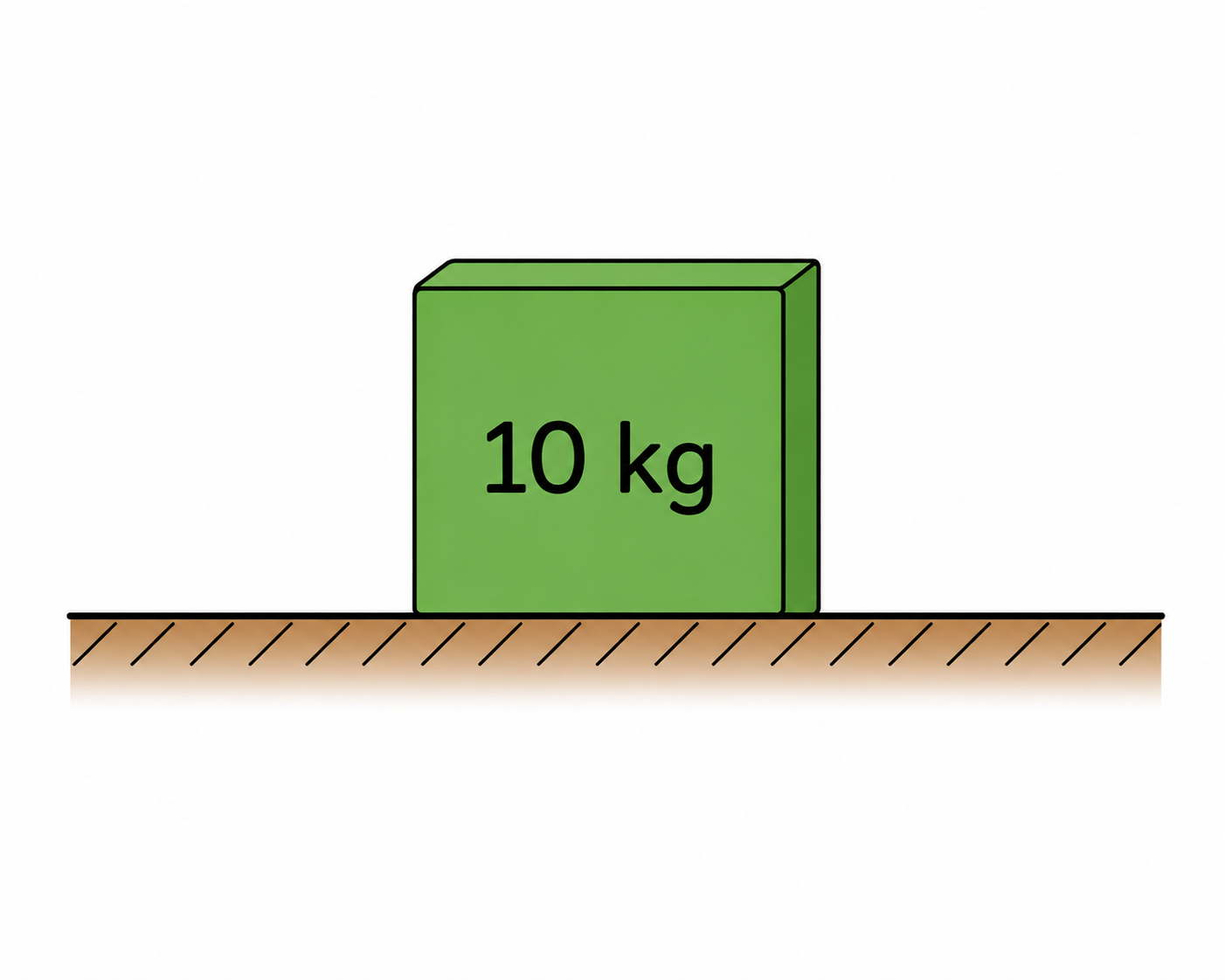
A 10 kg block is at rest on a horizontal rough surface. No horizontal force is applied to the block. What is the frictional force acting on the block?
Friction <-- Static Friction Basics
A
f = μN
B
f = mg
C
f = 0
D
f = μmg
✅ Show Answer
✔ Correct Answer:
C
(f = 0)
💡 Explanation
Given:
Mass of block, m = 10 kg
The block is at rest on a horizontal surface.
No horizontal force is applied.
Step 1: Identify the forces acting on the block.
Weight acts vertically downward:
W = mg
Normal reaction acts vertically upward:
N = mg
Step 2: Ask whether there is any tendency for the block to move horizontally.
There is no applied horizontal force, so there is no tendency for the block to slide.
Step 3: Determine the static friction.
Static friction is a self-adjusting force. It acts only when required to prevent relative motion.
Since there is no tendency for horizontal motion, no frictional force is required.
Therefore:
f = 0 N
Important: Static friction is NOT always equal to μN. The correct relation is:
f_s ≤ μ_s N
The maximum possible static friction is:
f_s,max = μ_s N
But the actual friction can be anywhere from 0 up to this maximum value.
Mass of block, m = 10 kg
The block is at rest on a horizontal surface.
No horizontal force is applied.
Step 1: Identify the forces acting on the block.
Weight acts vertically downward:
W = mg
Normal reaction acts vertically upward:
N = mg
Step 2: Ask whether there is any tendency for the block to move horizontally.
There is no applied horizontal force, so there is no tendency for the block to slide.
Step 3: Determine the static friction.
Static friction is a self-adjusting force. It acts only when required to prevent relative motion.
Since there is no tendency for horizontal motion, no frictional force is required.
Therefore:
f = 0 N
Important: Static friction is NOT always equal to μN. The correct relation is:
f_s ≤ μ_s N
The maximum possible static friction is:
f_s,max = μ_s N
But the actual friction can be anywhere from 0 up to this maximum value.
🎯 Conclusion
How to think about this problem:
1. First ask: Is the surface rough? If yes, friction is possible.
2. Next ask: Is there any tendency for the block to slide relative to the surface?
3. If there is no tendency for relative motion, no friction is needed.
4. Therefore, for a 10 kg block simply resting on a horizontal surface with no horizontal force:
f = 0 N.
Key idea:
Static friction does not automatically act just because two surfaces are rough or touching. It appears only when necessary to oppose a tendency of relative motion.
Remember:
Static friction: f_s ≤ μ_sN
Maximum static friction: f_s,max = μ_sN
Actual friction in this situation: f_s = 0.
1. First ask: Is the surface rough? If yes, friction is possible.
2. Next ask: Is there any tendency for the block to slide relative to the surface?
3. If there is no tendency for relative motion, no friction is needed.
4. Therefore, for a 10 kg block simply resting on a horizontal surface with no horizontal force:
f = 0 N.
Key idea:
Static friction does not automatically act just because two surfaces are rough or touching. It appears only when necessary to oppose a tendency of relative motion.
Remember:
Static friction: f_s ≤ μ_sN
Maximum static friction: f_s,max = μ_sN
Actual friction in this situation: f_s = 0.
2
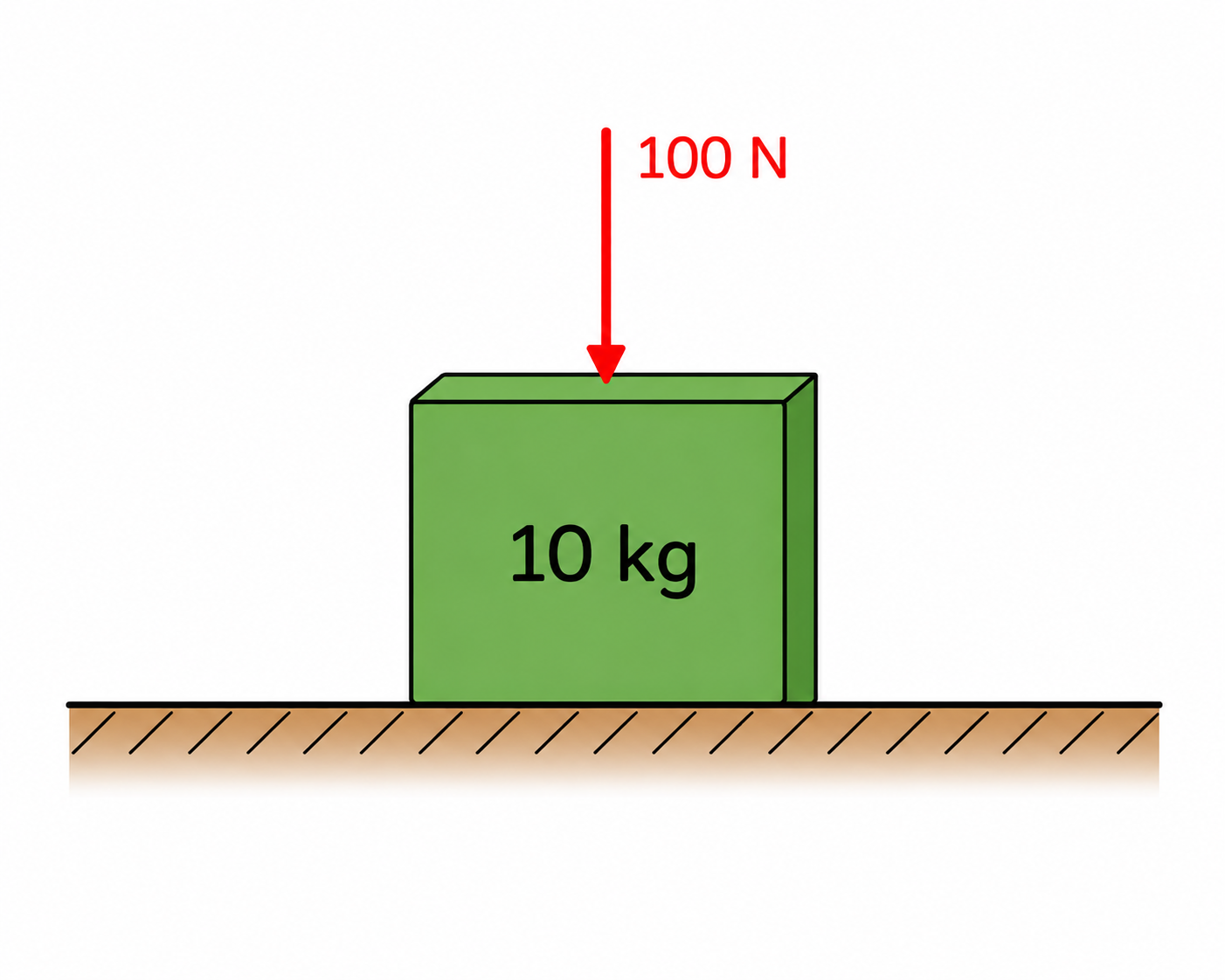
A 10 kg block is at rest on a rough horizontal surface. A vertical downward force of 100 N is applied to the block. What is the frictional force acting on the block? (Take g = 10 m/s²)
Friction <-- Static Friction Basics
A
f = 0 N
B
f = 100 N
C
f = μ(200) N
D
f = 200 N
✅ Show Answer
✔ Correct Answer:
A
(f = 0 N)
💡 Explanation
Given:
Mass of block, m = 10 kg
Downward applied force, F = 100 N
Acceleration due to gravity, g = 10 m/s²
Step 1: Calculate the weight of the block.
W = mg
W = 10 × 10 = 100 N
Step 2: Calculate the normal reaction.
Both the weight and the applied force act downward, so the surface must provide an equal upward normal reaction.
N = mg + F
N = 100 + 100 = 200 N
Step 3: Determine the frictional force.
Friction acts to oppose relative motion or the tendency of relative motion between the surfaces.
There is no horizontal force acting on the block and therefore no tendency for the block to move horizontally.
Hence, the actual static friction is:
f_s = 0 N
Important distinction:
The maximum possible static friction is:
f_s,max = μ_sN
Since N = 200 N:
f_s,max = 200μ_s N
But this is only the maximum possible friction, not the actual friction.
The actual friction is determined by the horizontal force that needs to be opposed.
Mass of block, m = 10 kg
Downward applied force, F = 100 N
Acceleration due to gravity, g = 10 m/s²
Step 1: Calculate the weight of the block.
W = mg
W = 10 × 10 = 100 N
Step 2: Calculate the normal reaction.
Both the weight and the applied force act downward, so the surface must provide an equal upward normal reaction.
N = mg + F
N = 100 + 100 = 200 N
Step 3: Determine the frictional force.
Friction acts to oppose relative motion or the tendency of relative motion between the surfaces.
There is no horizontal force acting on the block and therefore no tendency for the block to move horizontally.
Hence, the actual static friction is:
f_s = 0 N
Important distinction:
The maximum possible static friction is:
f_s,max = μ_sN
Since N = 200 N:
f_s,max = 200μ_s N
But this is only the maximum possible friction, not the actual friction.
The actual friction is determined by the horizontal force that needs to be opposed.
🎯 Conclusion
How to think about this problem:
1. First calculate the normal force. The additional downward force increases N.
2. Here, N = 200 N.
3. Then ask: Is there any horizontal force trying to move the block?
No.
4. Therefore, no friction is required to prevent horizontal motion.
5. Hence:
Actual friction = 0 N.
Do not confuse actual friction with maximum static friction:
f_s ≤ μ_sN
f_s,max = μ_sN
In this problem:
N = 200 N
f_s,max = 200μ_s N
but actual f_s = 0 N.
Key idea: Increasing the normal force increases the maximum possible static friction, but it does not create friction by itself.
1. First calculate the normal force. The additional downward force increases N.
2. Here, N = 200 N.
3. Then ask: Is there any horizontal force trying to move the block?
No.
4. Therefore, no friction is required to prevent horizontal motion.
5. Hence:
Actual friction = 0 N.
Do not confuse actual friction with maximum static friction:
f_s ≤ μ_sN
f_s,max = μ_sN
In this problem:
N = 200 N
f_s,max = 200μ_s N
but actual f_s = 0 N.
Key idea: Increasing the normal force increases the maximum possible static friction, but it does not create friction by itself.
3
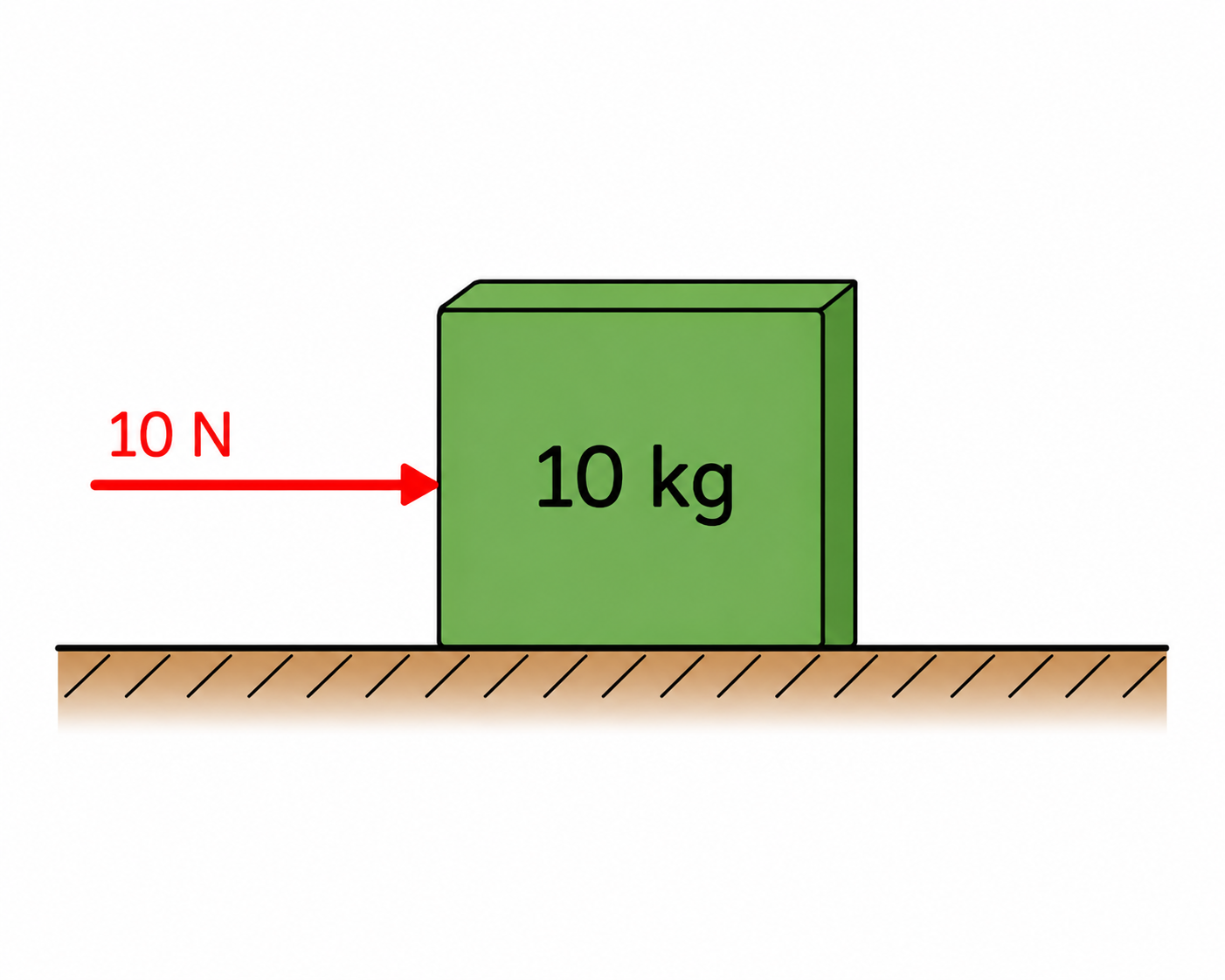
A 10 kg block is at rest on a rough horizontal surface. A horizontal force of 10 N is applied from left to right. The coefficient of static friction between the block and surface is μ_s = 0.7. What is the frictional force acting on the block? (Take g = 10 m/s²)
Friction <-- Static Friction
A
f_s = 0 N
B
f_s = 7 N
C
f_s = 10 N
D
f_s = 70 N
✅ Show Answer
✔ Correct Answer:
C
(f_s = 10 N)
💡 Explanation
Given:
Mass of block, m = 10 kg
Applied horizontal force, F = 10 N to the right
Coefficient of static friction, μ_s = 0.7
Acceleration due to gravity, g = 10 m/s²
Step 1: Calculate the normal reaction.
There is no vertical applied force, so:
N = mg
N = 10 × 10 = 100 N
Step 2: Calculate the maximum possible static friction.
f_s,max = μ_sN
f_s,max = 0.7 × 100 = 70 N
This means static friction can provide any required force up to 70 N.
Step 3: Compare the applied force with maximum static friction.
Applied force = 10 N
Maximum static friction = 70 N
Since:
10 N < 70 N
the block does not move. Static friction is therefore sufficient to prevent motion.
Step 4: Find the actual static friction.
Because the block remains at rest, the net horizontal force must be zero.
F - f_s = 0
10 - f_s = 0
Therefore:
f_s = 10 N
The frictional force acts toward the left, opposite to the applied force.
Mass of block, m = 10 kg
Applied horizontal force, F = 10 N to the right
Coefficient of static friction, μ_s = 0.7
Acceleration due to gravity, g = 10 m/s²
Step 1: Calculate the normal reaction.
There is no vertical applied force, so:
N = mg
N = 10 × 10 = 100 N
Step 2: Calculate the maximum possible static friction.
f_s,max = μ_sN
f_s,max = 0.7 × 100 = 70 N
This means static friction can provide any required force up to 70 N.
Step 3: Compare the applied force with maximum static friction.
Applied force = 10 N
Maximum static friction = 70 N
Since:
10 N < 70 N
the block does not move. Static friction is therefore sufficient to prevent motion.
Step 4: Find the actual static friction.
Because the block remains at rest, the net horizontal force must be zero.
F - f_s = 0
10 - f_s = 0
Therefore:
f_s = 10 N
The frictional force acts toward the left, opposite to the applied force.
🎯 Conclusion
How to think about this problem:
1. First calculate the normal force:
N = mg = 100 N.
2. Calculate the maximum static friction:
f_s,max = μ_sN = 70 N.
3. Compare the applied force with the maximum static friction:
10 N < 70 N.
4. Since static friction is strong enough to prevent motion, the block remains at rest.
5. Actual friction adjusts to exactly balance the applied force:
f_s = 10 N.
Key idea:
Static friction is NOT always equal to μ_sN.
The correct relation is:
f_s ≤ μ_sN
Here:
Actual static friction = 10 N
Maximum static friction = 70 N
A useful way to think about it: μ_sN is the maximum capacity of static friction. The actual friction is only as large as necessary to prevent slipping.
1. First calculate the normal force:
N = mg = 100 N.
2. Calculate the maximum static friction:
f_s,max = μ_sN = 70 N.
3. Compare the applied force with the maximum static friction:
10 N < 70 N.
4. Since static friction is strong enough to prevent motion, the block remains at rest.
5. Actual friction adjusts to exactly balance the applied force:
f_s = 10 N.
Key idea:
Static friction is NOT always equal to μ_sN.
The correct relation is:
f_s ≤ μ_sN
Here:
Actual static friction = 10 N
Maximum static friction = 70 N
A useful way to think about it: μ_sN is the maximum capacity of static friction. The actual friction is only as large as necessary to prevent slipping.
4
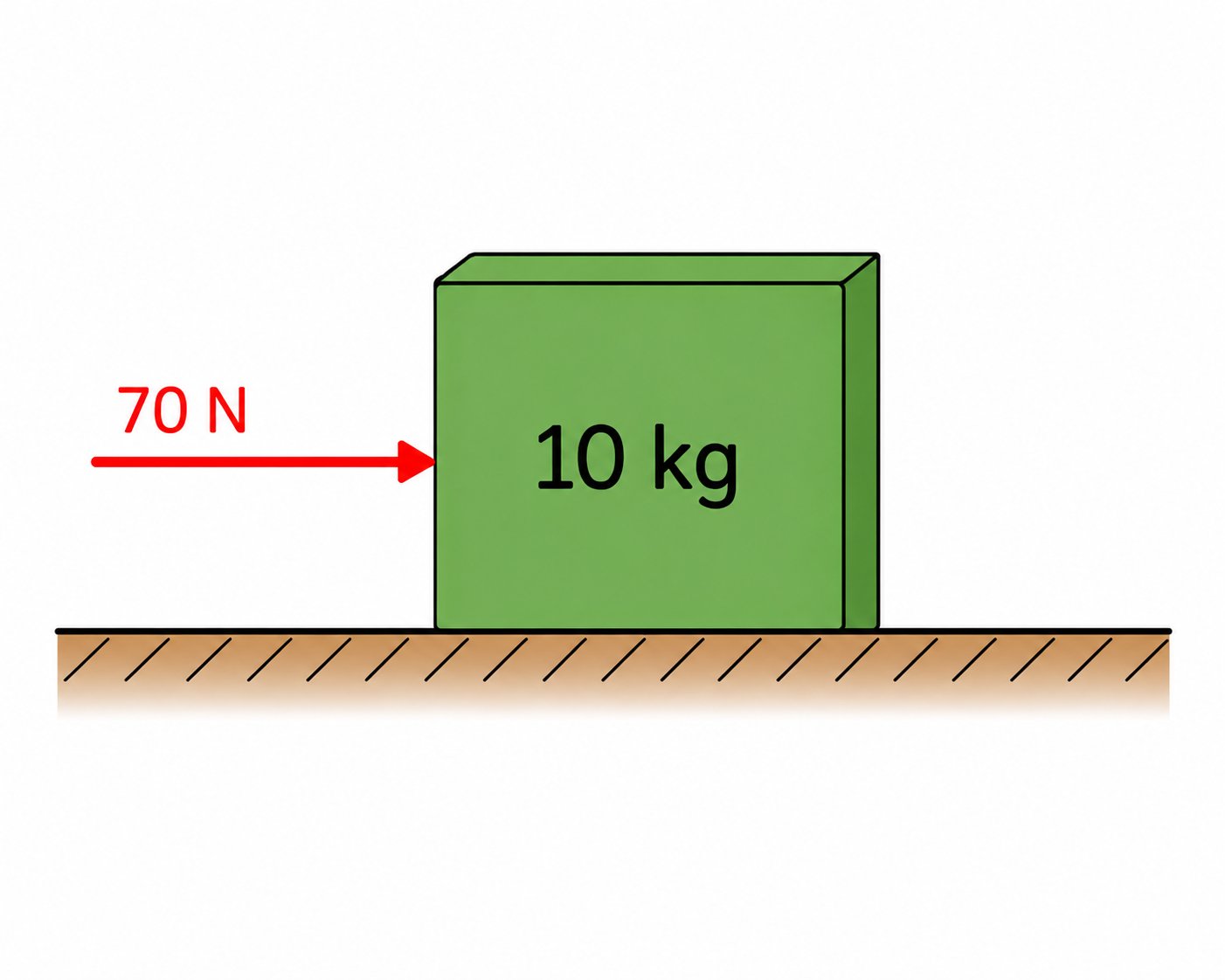
A 10 kg block is at rest on a rough horizontal surface. A horizontal force of 70 N is applied from left to right. The coefficient of static friction between the block and surface is μ_s = 0.7. What is the frictional force acting on the block? (Take g = 10 m/s²)
Friction <-- Limiting Friction
A
f_s = 0 N
B
f_s = 10 N
C
f_s = 49 N
D
f_s = 70 N
✅ Show Answer
✔ Correct Answer:
D
(f_s = 70 N)
💡 Explanation
Given:
Mass of block, m = 10 kg
Applied horizontal force, F = 70 N to the right
Coefficient of static friction, μ_s = 0.7
Acceleration due to gravity, g = 10 m/s²
Step 1: Calculate the normal reaction.
There is no vertical applied force, so:
N = mg
N = 10 × 10 = 100 N
Step 2: Calculate the maximum static friction.
f_s,max = μ_sN
f_s,max = 0.7 × 100 = 70 N
Step 3: Compare the applied force with the maximum static friction.
Applied force = 70 N
Maximum static friction = 70 N
The applied force is exactly equal to the maximum static friction.
Therefore, the block is at the limiting condition, also called impending motion.
Step 4: Determine the actual friction.
Since the block is still at rest, static friction balances the applied force:
F - f_s = 0
70 - f_s = 0
Therefore:
f_s = 70 N
The frictional force acts toward the left, opposite to the applied force.
Therefore, the actual static friction is 70 N and it is equal to the maximum possible static friction.
Mass of block, m = 10 kg
Applied horizontal force, F = 70 N to the right
Coefficient of static friction, μ_s = 0.7
Acceleration due to gravity, g = 10 m/s²
Step 1: Calculate the normal reaction.
There is no vertical applied force, so:
N = mg
N = 10 × 10 = 100 N
Step 2: Calculate the maximum static friction.
f_s,max = μ_sN
f_s,max = 0.7 × 100 = 70 N
Step 3: Compare the applied force with the maximum static friction.
Applied force = 70 N
Maximum static friction = 70 N
The applied force is exactly equal to the maximum static friction.
Therefore, the block is at the limiting condition, also called impending motion.
Step 4: Determine the actual friction.
Since the block is still at rest, static friction balances the applied force:
F - f_s = 0
70 - f_s = 0
Therefore:
f_s = 70 N
The frictional force acts toward the left, opposite to the applied force.
Therefore, the actual static friction is 70 N and it is equal to the maximum possible static friction.
🎯 Conclusion
How to think about this problem:
1. Calculate the normal force:
N = mg = 100 N.
2. Calculate the maximum static friction:
f_s,max = μ_sN = 70 N.
3. Compare the applied force with the maximum static friction:
F = 70 N and f_s,max = 70 N.
4. The applied force is exactly at the maximum limit of static friction.
5. Therefore, the block is just about to move, but while it remains at rest:
f_s = 70 N.
Key idea:
When the required static friction reaches its maximum value, we have limiting friction:
f_s = f_s,max = μ_sN.
In this problem:
Actual friction = 70 N
Maximum static friction = 70 N
The block is at the point of impending motion.
1. Calculate the normal force:
N = mg = 100 N.
2. Calculate the maximum static friction:
f_s,max = μ_sN = 70 N.
3. Compare the applied force with the maximum static friction:
F = 70 N and f_s,max = 70 N.
4. The applied force is exactly at the maximum limit of static friction.
5. Therefore, the block is just about to move, but while it remains at rest:
f_s = 70 N.
Key idea:
When the required static friction reaches its maximum value, we have limiting friction:
f_s = f_s,max = μ_sN.
In this problem:
Actual friction = 70 N
Maximum static friction = 70 N
The block is at the point of impending motion.
5
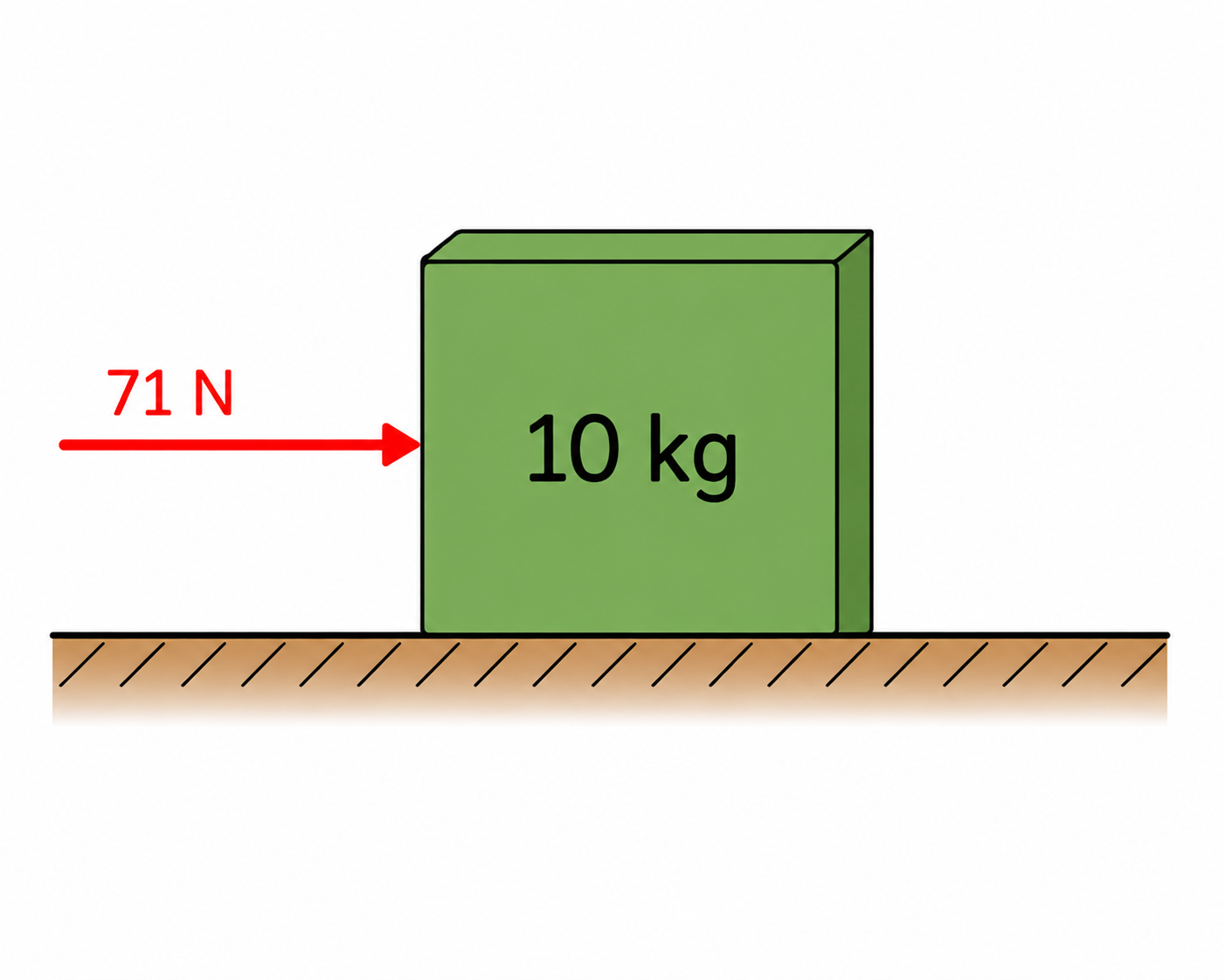
A 10 kg block is initially at rest on a rough horizontal surface. A horizontal force of 71 N is applied from left to right. The coefficient of static friction between the block and surface is μ_s = 0.7. What can be concluded about the frictional force? (Take g = 10 m/s²)
Friction <-- Kinetic Friction
A
f_s = 0 N and the block remains at rest
B
f_s = 71 N and the block remains at rest
C
f_s = 70 N and the block remains at rest
D
Static friction cannot balance the force; the block starts moving and kinetic friction must be used
✅ Show Answer
✔ Correct Answer:
D
(Static friction cannot balance the force; the block starts moving and kinetic friction must be used)
💡 Explanation
Given:
Mass of block, m = 10 kg
Applied horizontal force, F = 71 N to the right
Coefficient of static friction, μ_s = 0.7
Acceleration due to gravity, g = 10 m/s²
Step 1: Calculate the normal reaction.
There is no vertical applied force, so:
N = mg
N = 10 × 10 = 100 N
Step 2: Calculate the maximum static friction.
f_s,max = μ_sN
f_s,max = 0.7 × 100 = 70 N
Step 3: Compare the applied force with the maximum static friction.
Applied force = 71 N
Maximum static friction = 70 N
Since:
71 N > 70 N
static friction is not strong enough to prevent the block from moving.
Therefore, the block starts moving.
Step 4: Determine the type of friction after motion begins.
Once the surfaces are sliding relative to each other, static friction is no longer used.
The friction becomes kinetic friction:
f_k = μ_kN
The value of μ_k has not been given, so the numerical value of kinetic friction cannot yet be calculated.
Therefore, we cannot say that the friction is 71 N. The maximum static friction is only 70 N, and the block begins to move.
Mass of block, m = 10 kg
Applied horizontal force, F = 71 N to the right
Coefficient of static friction, μ_s = 0.7
Acceleration due to gravity, g = 10 m/s²
Step 1: Calculate the normal reaction.
There is no vertical applied force, so:
N = mg
N = 10 × 10 = 100 N
Step 2: Calculate the maximum static friction.
f_s,max = μ_sN
f_s,max = 0.7 × 100 = 70 N
Step 3: Compare the applied force with the maximum static friction.
Applied force = 71 N
Maximum static friction = 70 N
Since:
71 N > 70 N
static friction is not strong enough to prevent the block from moving.
Therefore, the block starts moving.
Step 4: Determine the type of friction after motion begins.
Once the surfaces are sliding relative to each other, static friction is no longer used.
The friction becomes kinetic friction:
f_k = μ_kN
The value of μ_k has not been given, so the numerical value of kinetic friction cannot yet be calculated.
Therefore, we cannot say that the friction is 71 N. The maximum static friction is only 70 N, and the block begins to move.
🎯 Conclusion
How to think about this problem:
1. Calculate the normal force:
N = mg = 100 N.
2. Calculate maximum static friction:
f_s,max = μ_sN = 70 N.
3. Compare the applied force with the maximum static friction:
71 N > 70 N.
4. Static friction cannot provide the required 71 N force.
5. Therefore, the block starts moving.
6. Once the block moves, use kinetic friction:
f_k = μ_kN.
The important transition is:
F < f_s,max → static friction adjusts to F.
F = f_s,max → limiting friction; block is about to move.
F > f_s,max → block moves; use kinetic friction.
In this problem:
F = 71 N
f_s,max = 70 N
Therefore, motion begins and μ_k is required to determine the actual friction.
1. Calculate the normal force:
N = mg = 100 N.
2. Calculate maximum static friction:
f_s,max = μ_sN = 70 N.
3. Compare the applied force with the maximum static friction:
71 N > 70 N.
4. Static friction cannot provide the required 71 N force.
5. Therefore, the block starts moving.
6. Once the block moves, use kinetic friction:
f_k = μ_kN.
The important transition is:
F < f_s,max → static friction adjusts to F.
F = f_s,max → limiting friction; block is about to move.
F > f_s,max → block moves; use kinetic friction.
In this problem:
F = 71 N
f_s,max = 70 N
Therefore, motion begins and μ_k is required to determine the actual friction.
6
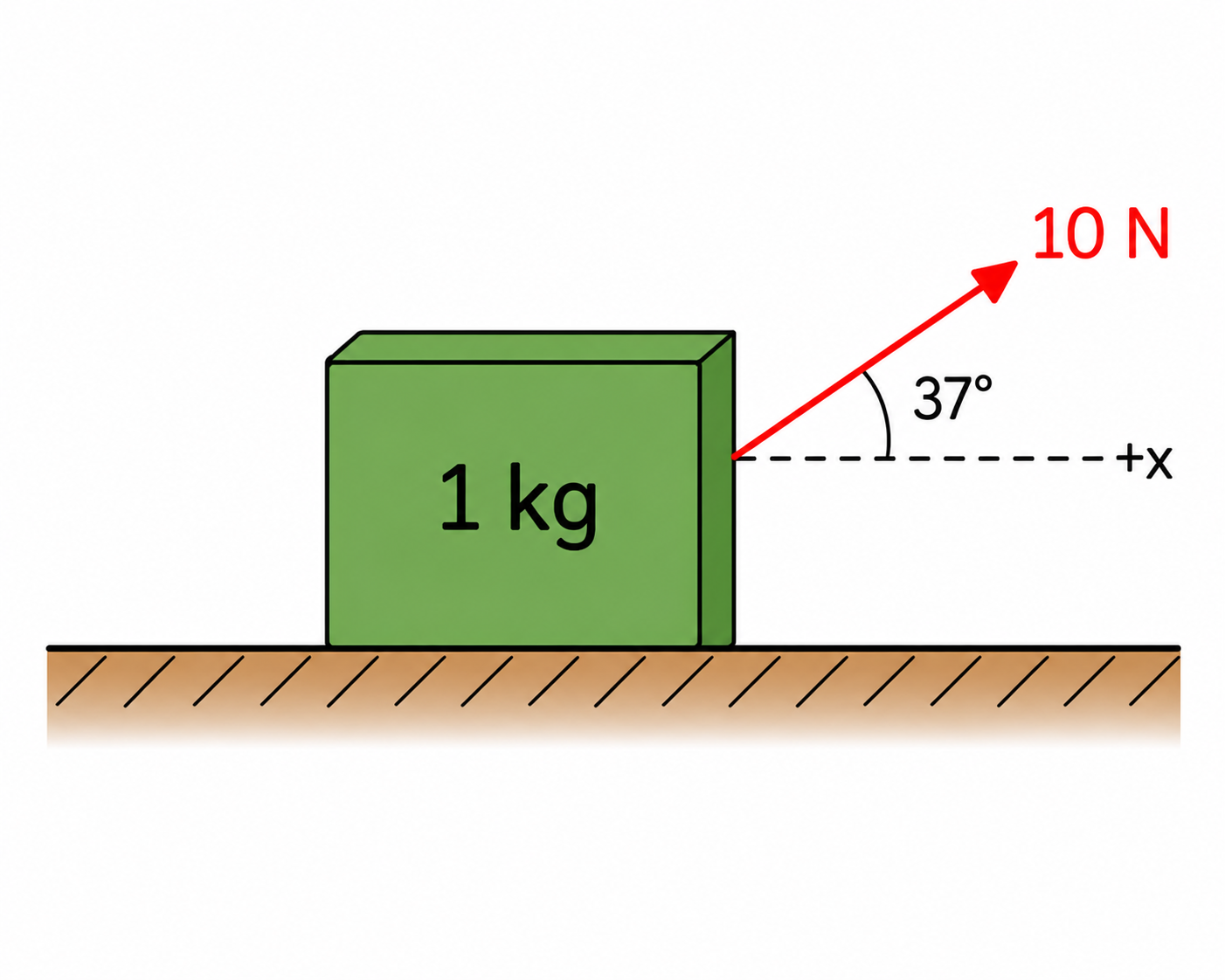
A 5 N force is pulling a 1 kg block at 37° to the +x direction on a rough horizontal surface. The coefficient of static friction is μ_s = 1. Assume g = 10 m/s². What is the frictional force acting on the block?
Friction <-- Static Friction with Inclined Force
A
f_s = 0 N
B
f_s = 4 N toward -x
C
f_s = 7 N toward -x
D
f_s = 5 N toward -x
✅ Show Answer
✔ Correct Answer:
B
(f_s = 4 N toward -x)
💡 Explanation
Given:
Mass of block, m = 1 kg
Applied pulling force, F = 5 N
Angle of pulling force, θ = 37° above the +x direction
Coefficient of static friction, μ_s = 1
Acceleration due to gravity, g = 10 m/s²
Use:
sin37° = 3/5
cos37° = 4/5
Step 1: Resolve the applied force into horizontal and vertical components.
Horizontal component:
F_x = F cos37°
F_x = 5 × (4/5) = 4 N
Vertical component:
F_y = F sin37°
F_y = 5 × (3/5) = 3 N
The 3 N vertical component acts upward and therefore reduces the normal reaction.
Step 2: Calculate the normal reaction.
The weight of the block is:
mg = 1 × 10 = 10 N
Since there is no vertical acceleration:
N + F_y - mg = 0
N + 3 - 10 = 0
N = 7 N
Step 3: Calculate the maximum static friction.
f_s,max = μ_sN
f_s,max = 1 × 7 = 7 N
Step 4: Compare the horizontal force with the maximum static friction.
Horizontal applied force = 4 N
Maximum static friction = 7 N
Since:
4 N < 7 N
the block remains at rest. Static friction therefore adjusts itself to exactly oppose the horizontal component of the applied force.
Thus:
f_s = 4 N
The applied force tries to move the block in the +x direction, so friction acts in the -x direction.
Mass of block, m = 1 kg
Applied pulling force, F = 5 N
Angle of pulling force, θ = 37° above the +x direction
Coefficient of static friction, μ_s = 1
Acceleration due to gravity, g = 10 m/s²
Use:
sin37° = 3/5
cos37° = 4/5
Step 1: Resolve the applied force into horizontal and vertical components.
Horizontal component:
F_x = F cos37°
F_x = 5 × (4/5) = 4 N
Vertical component:
F_y = F sin37°
F_y = 5 × (3/5) = 3 N
The 3 N vertical component acts upward and therefore reduces the normal reaction.
Step 2: Calculate the normal reaction.
The weight of the block is:
mg = 1 × 10 = 10 N
Since there is no vertical acceleration:
N + F_y - mg = 0
N + 3 - 10 = 0
N = 7 N
Step 3: Calculate the maximum static friction.
f_s,max = μ_sN
f_s,max = 1 × 7 = 7 N
Step 4: Compare the horizontal force with the maximum static friction.
Horizontal applied force = 4 N
Maximum static friction = 7 N
Since:
4 N < 7 N
the block remains at rest. Static friction therefore adjusts itself to exactly oppose the horizontal component of the applied force.
Thus:
f_s = 4 N
The applied force tries to move the block in the +x direction, so friction acts in the -x direction.
🎯 Conclusion
How to think about this problem:
1. When a force is applied at an angle, first resolve it into horizontal and vertical components.
2. The horizontal component tries to move the block:
F_x = 4 N.
3. The upward component reduces the normal force:
N = 7 N.
4. Calculate the maximum static friction:
f_s,max = μ_sN = 7 N.
5. Compare the required friction with the maximum available friction:
4 N < 7 N.
6. Since static friction is sufficient to prevent motion, the actual friction is:
f_s = 4 N toward -x.
Key idea:
For static friction, μ_sN gives the maximum possible friction, not necessarily the actual friction.
Here:
Actual friction = 4 N
Maximum static friction = 7 N.
1. When a force is applied at an angle, first resolve it into horizontal and vertical components.
2. The horizontal component tries to move the block:
F_x = 4 N.
3. The upward component reduces the normal force:
N = 7 N.
4. Calculate the maximum static friction:
f_s,max = μ_sN = 7 N.
5. Compare the required friction with the maximum available friction:
4 N < 7 N.
6. Since static friction is sufficient to prevent motion, the actual friction is:
f_s = 4 N toward -x.
Key idea:
For static friction, μ_sN gives the maximum possible friction, not necessarily the actual friction.
Here:
Actual friction = 4 N
Maximum static friction = 7 N.
7
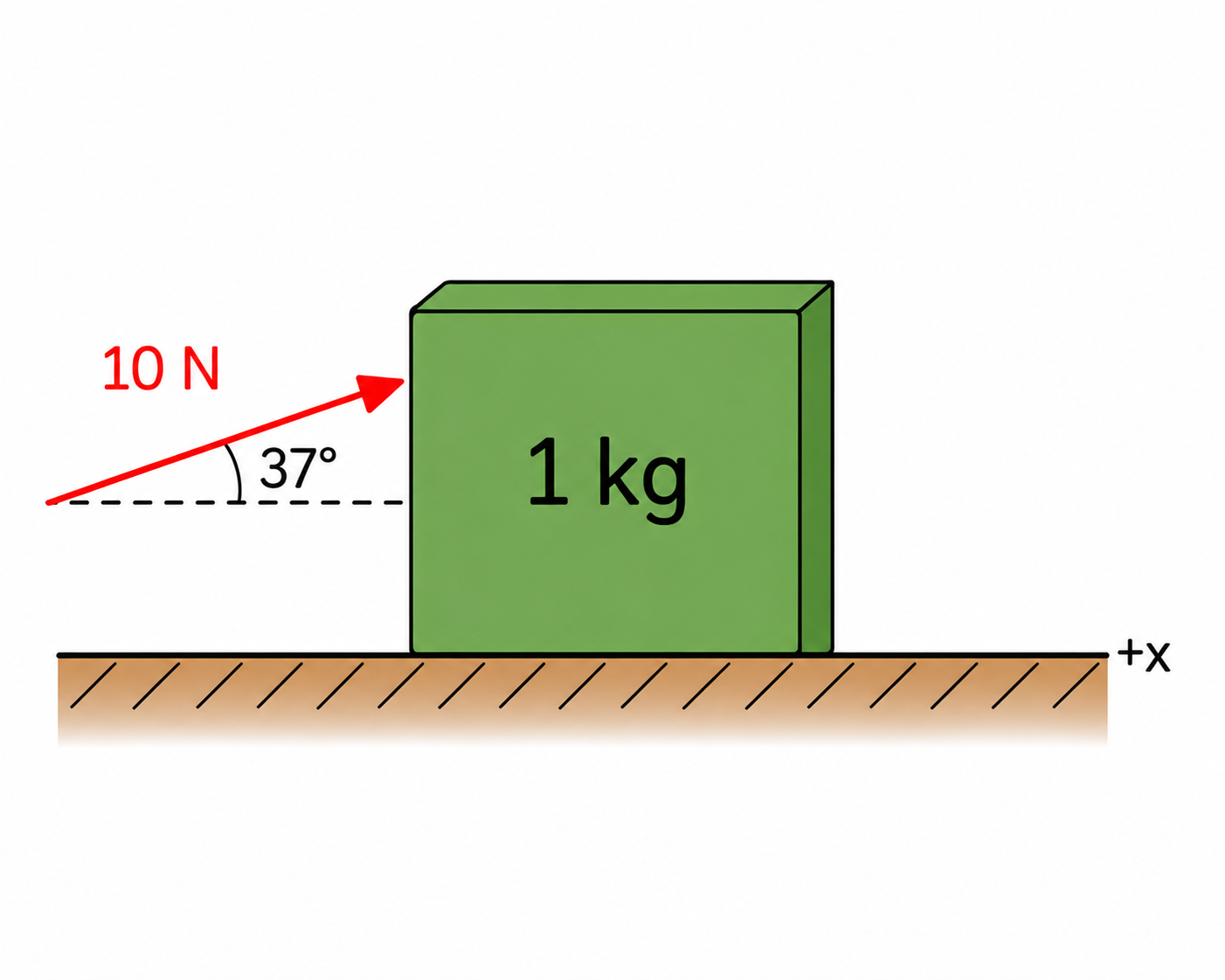
A 5 N force is pushing a 1 kg block at 37° below the +x direction on a rough horizontal surface. The coefficient of static friction is μ_s = 1. Assume g = 10 m/s². What is the frictional force acting on the block?
Friction <-- Static Friction with Angled Push
A
f_s = 0 N
B
f_s = 4 N toward -x
C
f_s = 13 N toward -x
D
f_s = 5 N toward -x
✅ Show Answer
✔ Correct Answer:
B
(f_s = 4 N toward -x)
💡 Explanation
Given:
Mass of block, m = 1 kg
Applied pushing force, F = 5 N
Angle of pushing force, θ = 37° below the +x direction
Coefficient of static friction, μ_s = 1
Acceleration due to gravity, g = 10 m/s²
Use:
sin37° = 3/5
cos37° = 4/5
Step 1: Resolve the applied force into horizontal and vertical components.
Horizontal component:
F_x = F cos37°
F_x = 5 × (4/5) = 4 N
Vertical component:
F_y = F sin37°
F_y = 5 × (3/5) = 3 N
Since the force is pushing downward at 37°, the vertical component acts downward.
Step 2: Calculate the normal reaction.
The weight of the block is:
mg = 1 × 10 = 10 N
Both the weight and the vertical component of the applied force act downward.
Therefore:
N = mg + F_y
N = 10 + 3 = 13 N
Step 3: Calculate the maximum static friction.
f_s,max = μ_sN
f_s,max = 1 × 13 = 13 N
Step 4: Compare the horizontal force with the maximum static friction.
Horizontal applied force = 4 N
Maximum static friction = 13 N
Since:
4 N < 13 N
the block remains at rest. Static friction is sufficient to prevent horizontal motion.
Therefore, the actual static friction adjusts to exactly balance the horizontal component:
f_s = 4 N
The applied force tries to move the block in the +x direction, so friction acts in the -x direction.
Mass of block, m = 1 kg
Applied pushing force, F = 5 N
Angle of pushing force, θ = 37° below the +x direction
Coefficient of static friction, μ_s = 1
Acceleration due to gravity, g = 10 m/s²
Use:
sin37° = 3/5
cos37° = 4/5
Step 1: Resolve the applied force into horizontal and vertical components.
Horizontal component:
F_x = F cos37°
F_x = 5 × (4/5) = 4 N
Vertical component:
F_y = F sin37°
F_y = 5 × (3/5) = 3 N
Since the force is pushing downward at 37°, the vertical component acts downward.
Step 2: Calculate the normal reaction.
The weight of the block is:
mg = 1 × 10 = 10 N
Both the weight and the vertical component of the applied force act downward.
Therefore:
N = mg + F_y
N = 10 + 3 = 13 N
Step 3: Calculate the maximum static friction.
f_s,max = μ_sN
f_s,max = 1 × 13 = 13 N
Step 4: Compare the horizontal force with the maximum static friction.
Horizontal applied force = 4 N
Maximum static friction = 13 N
Since:
4 N < 13 N
the block remains at rest. Static friction is sufficient to prevent horizontal motion.
Therefore, the actual static friction adjusts to exactly balance the horizontal component:
f_s = 4 N
The applied force tries to move the block in the +x direction, so friction acts in the -x direction.
🎯 Conclusion
How to think about this problem:
1. Resolve the angled force into horizontal and vertical components.
2. The horizontal component tries to move the block:
F_x = 4 N.
3. Because the force is pushing downward, its vertical component increases the normal force:
N = mg + F_y = 13 N.
4. Calculate maximum static friction:
f_s,max = μ_sN = 13 N.
5. Compare the required friction with the maximum available friction:
4 N < 13 N.
6. Since static friction is sufficient to prevent motion, the actual friction is:
f_s = 4 N toward -x.
Key idea:
An angled pushing force increases the normal force, which increases the maximum possible static friction.
However, the actual static friction is determined by the horizontal force that must be opposed.
Here:
Actual friction = 4 N
Maximum static friction = 13 N.
1. Resolve the angled force into horizontal and vertical components.
2. The horizontal component tries to move the block:
F_x = 4 N.
3. Because the force is pushing downward, its vertical component increases the normal force:
N = mg + F_y = 13 N.
4. Calculate maximum static friction:
f_s,max = μ_sN = 13 N.
5. Compare the required friction with the maximum available friction:
4 N < 13 N.
6. Since static friction is sufficient to prevent motion, the actual friction is:
f_s = 4 N toward -x.
Key idea:
An angled pushing force increases the normal force, which increases the maximum possible static friction.
However, the actual static friction is determined by the horizontal force that must be opposed.
Here:
Actual friction = 4 N
Maximum static friction = 13 N.
8
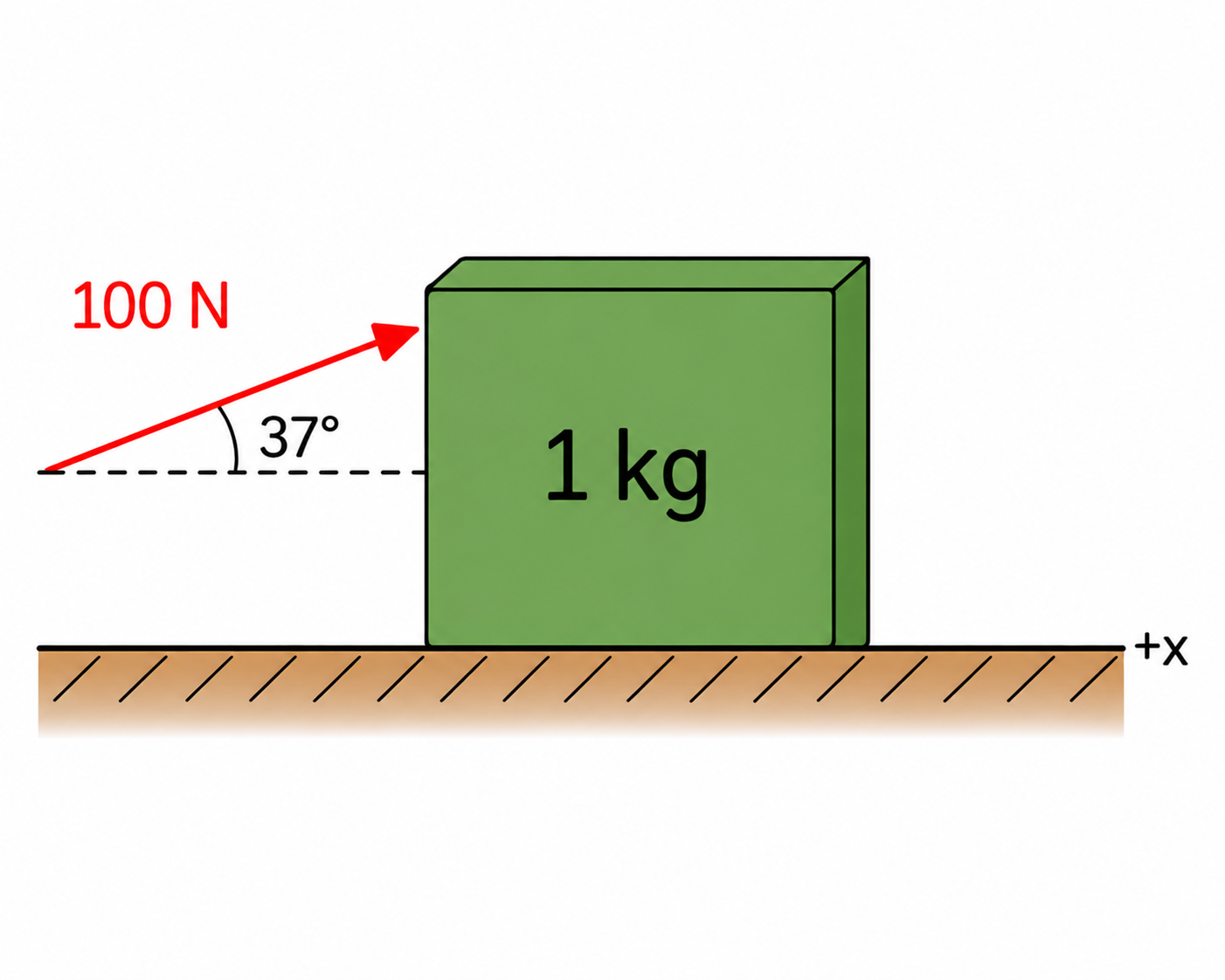
A 100 N force is pushing a 1 kg block at 37° below the +x direction on a rough horizontal surface. The coefficient of static friction is μ_s = 1 and the coefficient of kinetic friction is μ_k = 1. Assume g = 10 m/s². What is the acceleration of the block?
Friction <-- Kinetic Friction with Angled Push, Acceleration
A
a = 0 m/s²
B
a = 5 m/s² toward +x
C
a = 10 m/s² toward +x
D
a = 20 m/s² toward +x
✅ Show Answer
✔ Correct Answer:
C
(a = 10 m/s² toward +x)
💡 Explanation
Given:
Mass of block, m = 1 kg
Applied pushing force, F = 100 N
Angle of force, θ = 37° below the +x direction
Coefficient of static friction, μ_s = 1
Coefficient of kinetic friction, μ_k = 1
Acceleration due to gravity, g = 10 m/s²
Use:
sin37° = 3/5
cos37° = 4/5
Step 1: Resolve the applied force into horizontal and vertical components.
Horizontal component:
F_x = F cos37°
F_x = 100 × (4/5) = 80 N
Downward component:
F_y = F sin37°
F_y = 100 × (3/5) = 60 N
Step 2: Determine whether the block moves.
The normal force is:
N = mg + F_y
N = 10 + 60 = 70 N
Maximum static friction is:
f_s,max = μ_sN
f_s,max = 1 × 70 = 70 N
The horizontal applied force is 80 N.
Since 80 N > 70 N, static friction cannot prevent motion.
Therefore, the block starts moving and kinetic friction must be used.
Step 3: Calculate kinetic friction.
f_k = μ_kN
f_k = 1 × 70 = 70 N
Kinetic friction acts opposite to the direction of motion, so it acts toward the -x direction.
Step 4: Calculate the net horizontal force.
Net force = F_x - f_k
Net force = 80 - 70 = 10 N
Step 5: Calculate acceleration using Newton's second law.
F_net = ma
10 = 1 × a
Therefore:
a = 10 m/s²
The acceleration is toward the +x direction.
Mass of block, m = 1 kg
Applied pushing force, F = 100 N
Angle of force, θ = 37° below the +x direction
Coefficient of static friction, μ_s = 1
Coefficient of kinetic friction, μ_k = 1
Acceleration due to gravity, g = 10 m/s²
Use:
sin37° = 3/5
cos37° = 4/5
Step 1: Resolve the applied force into horizontal and vertical components.
Horizontal component:
F_x = F cos37°
F_x = 100 × (4/5) = 80 N
Downward component:
F_y = F sin37°
F_y = 100 × (3/5) = 60 N
Step 2: Determine whether the block moves.
The normal force is:
N = mg + F_y
N = 10 + 60 = 70 N
Maximum static friction is:
f_s,max = μ_sN
f_s,max = 1 × 70 = 70 N
The horizontal applied force is 80 N.
Since 80 N > 70 N, static friction cannot prevent motion.
Therefore, the block starts moving and kinetic friction must be used.
Step 3: Calculate kinetic friction.
f_k = μ_kN
f_k = 1 × 70 = 70 N
Kinetic friction acts opposite to the direction of motion, so it acts toward the -x direction.
Step 4: Calculate the net horizontal force.
Net force = F_x - f_k
Net force = 80 - 70 = 10 N
Step 5: Calculate acceleration using Newton's second law.
F_net = ma
10 = 1 × a
Therefore:
a = 10 m/s²
The acceleration is toward the +x direction.
🎯 Conclusion
How to think about this problem:
1. Resolve the angled pushing force into horizontal and vertical components.
F_x = 80 N and F_y = 60 N downward.
2. The downward component increases the normal force:
N = mg + F_y = 70 N.
3. Check static friction first:
f_s,max = μ_sN = 70 N.
Since F_x = 80 N > 70 N, the block moves.
4. Once the block moves, use kinetic friction:
f_k = μ_kN = 70 N.
5. Find the net horizontal force:
F_net = 80 - 70 = 10 N.
6. Apply Newton's second law:
a = F_net/m = 10/1 = 10 m/s².
Therefore:
a = 10 m/s² toward +x.
Key idea:
For an angled pushing force, the downward component increases N, which increases kinetic friction. Always calculate N before calculating friction.
1. Resolve the angled pushing force into horizontal and vertical components.
F_x = 80 N and F_y = 60 N downward.
2. The downward component increases the normal force:
N = mg + F_y = 70 N.
3. Check static friction first:
f_s,max = μ_sN = 70 N.
Since F_x = 80 N > 70 N, the block moves.
4. Once the block moves, use kinetic friction:
f_k = μ_kN = 70 N.
5. Find the net horizontal force:
F_net = 80 - 70 = 10 N.
6. Apply Newton's second law:
a = F_net/m = 10/1 = 10 m/s².
Therefore:
a = 10 m/s² toward +x.
Key idea:
For an angled pushing force, the downward component increases N, which increases kinetic friction. Always calculate N before calculating friction.
9
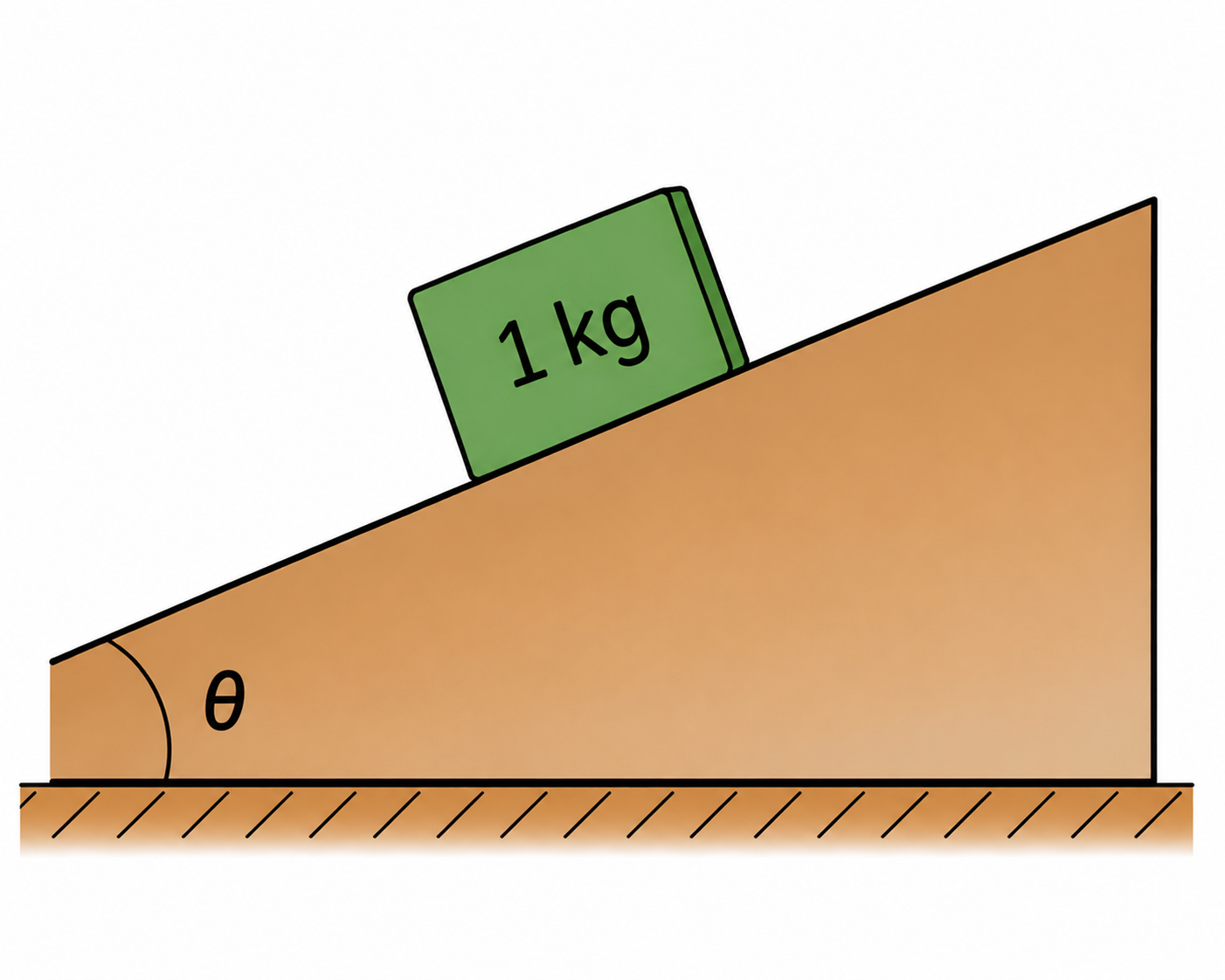
A 1 kg block is placed on a rough inclined surface on Earth. The coefficient of static friction between the block and the surface is μ_s = 1. What is the maximum angle of inclination at which the block is just about to move downward? (Take g = 10 m/s²)
Friction <-- Angle of Repose
A
θ_max = 30°
B
θ_max = 37°
C
θ_max = 45°
D
θ_max = 60°
✅ Show Answer
✔ Correct Answer:
C
(θ_max = 45°)
💡 Explanation
Given:
Mass of block, m = 1 kg
Coefficient of static friction, μ_s = 1
Acceleration due to gravity, g = 10 m/s²
The block is just about to move downward, so the component of gravity pulling the block down the incline is exactly balanced by maximum static friction.
Step 1: Resolve the weight along the incline.
The component of weight acting down the incline is:
mg sinθ
Step 2: Calculate the normal reaction.
The component of weight perpendicular to the incline is:
N = mg cosθ
Step 3: Calculate the maximum static friction.
f_s,max = μ_sN
f_s,max = μ_smg cosθ
Step 4: Apply the condition for impending downward motion.
At the maximum angle, the block is just about to move downward, so:
mg sinθ = μ_smg cosθ
Cancel mg from both sides:
sinθ = μ_s cosθ
Therefore:
tanθ = μ_s
Since μ_s = 1:
tanθ = 1
Therefore:
θ_max = tan⁻¹(1) = 45°
The block is just about to slide downward at an inclination of 45°.
Mass of block, m = 1 kg
Coefficient of static friction, μ_s = 1
Acceleration due to gravity, g = 10 m/s²
The block is just about to move downward, so the component of gravity pulling the block down the incline is exactly balanced by maximum static friction.
Step 1: Resolve the weight along the incline.
The component of weight acting down the incline is:
mg sinθ
Step 2: Calculate the normal reaction.
The component of weight perpendicular to the incline is:
N = mg cosθ
Step 3: Calculate the maximum static friction.
f_s,max = μ_sN
f_s,max = μ_smg cosθ
Step 4: Apply the condition for impending downward motion.
At the maximum angle, the block is just about to move downward, so:
mg sinθ = μ_smg cosθ
Cancel mg from both sides:
sinθ = μ_s cosθ
Therefore:
tanθ = μ_s
Since μ_s = 1:
tanθ = 1
Therefore:
θ_max = tan⁻¹(1) = 45°
The block is just about to slide downward at an inclination of 45°.
🎯 Conclusion
How to think about this problem:
1. Gravity has a component mg sinθ pulling the block down the incline.
2. The normal reaction is N = mg cosθ.
3. Maximum static friction is μ_sN = μ_smg cosθ.
4. At the angle where the block is just about to move downward, these two forces are equal:
mg sinθ = μ_smg cosθ.
5. Cancel mg:
tanθ = μ_s.
6. With μ_s = 1:
tanθ = 1.
Therefore:
θ_max = 45°.
Key idea:
The maximum angle before sliding begins is called the angle of repose.
For a rough inclined surface:
tanθ_repose = μ_s.
Notice that the mass of the block does not affect the angle of repose because m cancels from the equation.
1. Gravity has a component mg sinθ pulling the block down the incline.
2. The normal reaction is N = mg cosθ.
3. Maximum static friction is μ_sN = μ_smg cosθ.
4. At the angle where the block is just about to move downward, these two forces are equal:
mg sinθ = μ_smg cosθ.
5. Cancel mg:
tanθ = μ_s.
6. With μ_s = 1:
tanθ = 1.
Therefore:
θ_max = 45°.
Key idea:
The maximum angle before sliding begins is called the angle of repose.
For a rough inclined surface:
tanθ_repose = μ_s.
Notice that the mass of the block does not affect the angle of repose because m cancels from the equation.
10
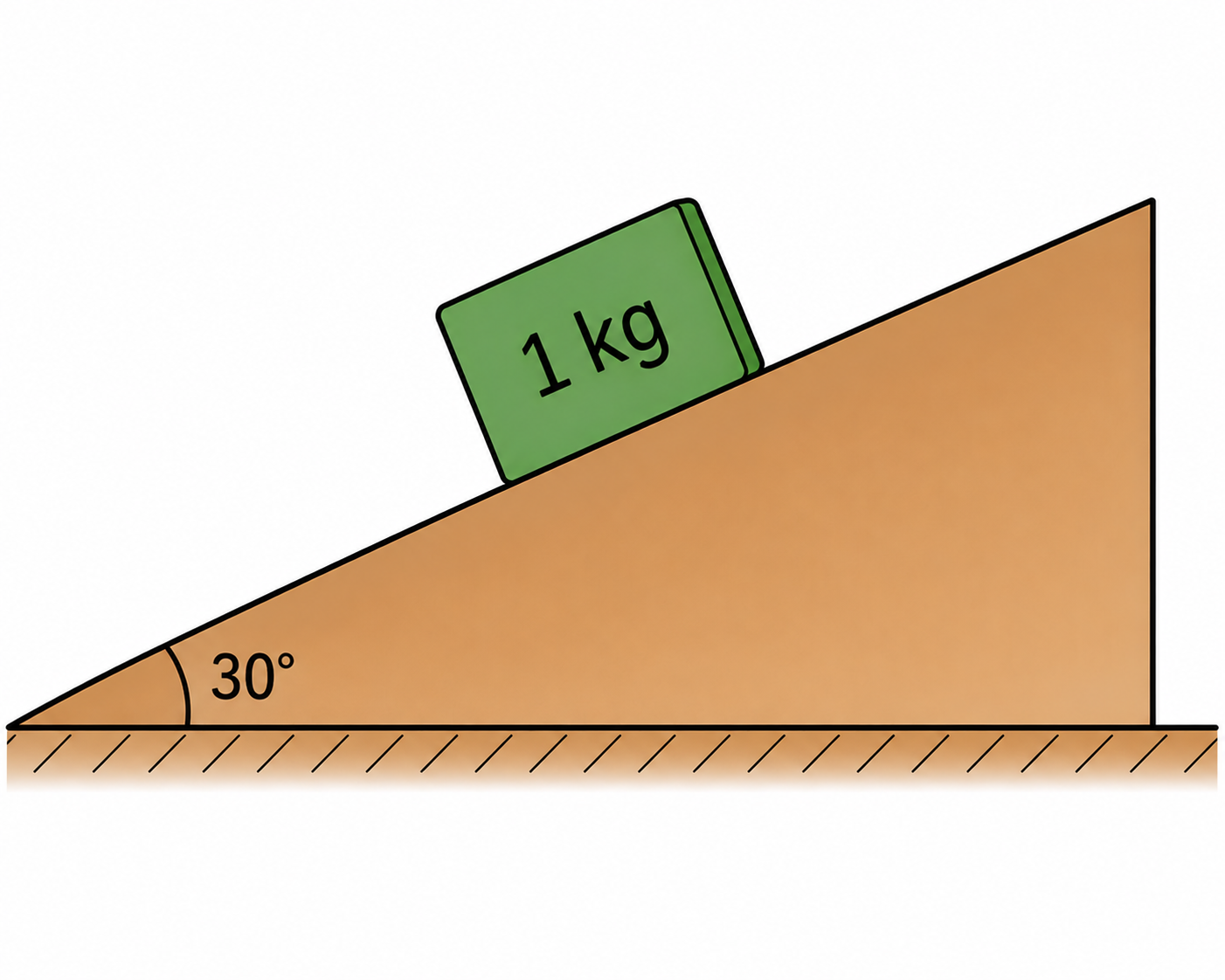
A 1 kg block is placed on a rough inclined surface at an angle of 30°. The coefficient of static friction between the block and the surface is μ_s = 1. What minimum force must be applied parallel to the incline upward to make the block just start moving upward? (Take g = 10 m/s²)
Friction <-- Inclined Plane, less than tan(μ_s)
A
F = 5 N
B
F = 5√3 N
C
F = 5(1 + √3) N
D
F = 10√3 N
✅ Show Answer
✔ Correct Answer:
C
(F = 5(1 + √3) N)
💡 Explanation
Given:
Mass of block, m = 1 kg
Inclination angle, θ = 30°
Coefficient of static friction, μ_s = 1
Acceleration due to gravity, g = 10 m/s²
The applied force is parallel to the incline and directed upward.
Step 1: Determine the component of weight along the incline.
The component of gravity acting down the incline is:
mg sinθ
= 1 × 10 × sin30°
= 10 × (1/2)
= 5 N
Step 2: Determine the normal reaction.
Since the applied force is parallel to the incline, it has no component perpendicular to the surface.
Therefore:
N = mg cosθ
= 10 cos30°
= 10 × (√3/2)
= 5√3 N
Step 3: Determine the maximum static friction.
Since the block is about to move upward, friction acts downward along the incline.
f_s,max = μ_sN
= 1 × 5√3
= 5√3 N
Step 4: Find the minimum applied force.
At the instant the block is about to move upward, the applied force must overcome both the downward component of gravity and maximum static friction.
F = mg sinθ + f_s,max
F = 5 + 5√3
F = 5(1 + √3) N
Numerically:
F ≈ 5(1 + 1.732)
F ≈ 13.66 N
Therefore, the minimum applied force required to just start moving the block upward is approximately 13.66 N.
Mass of block, m = 1 kg
Inclination angle, θ = 30°
Coefficient of static friction, μ_s = 1
Acceleration due to gravity, g = 10 m/s²
The applied force is parallel to the incline and directed upward.
Step 1: Determine the component of weight along the incline.
The component of gravity acting down the incline is:
mg sinθ
= 1 × 10 × sin30°
= 10 × (1/2)
= 5 N
Step 2: Determine the normal reaction.
Since the applied force is parallel to the incline, it has no component perpendicular to the surface.
Therefore:
N = mg cosθ
= 10 cos30°
= 10 × (√3/2)
= 5√3 N
Step 3: Determine the maximum static friction.
Since the block is about to move upward, friction acts downward along the incline.
f_s,max = μ_sN
= 1 × 5√3
= 5√3 N
Step 4: Find the minimum applied force.
At the instant the block is about to move upward, the applied force must overcome both the downward component of gravity and maximum static friction.
F = mg sinθ + f_s,max
F = 5 + 5√3
F = 5(1 + √3) N
Numerically:
F ≈ 5(1 + 1.732)
F ≈ 13.66 N
Therefore, the minimum applied force required to just start moving the block upward is approximately 13.66 N.
🎯 Conclusion
How to think about this problem:
1. Decide which direction the block is about to move. Here it is upward along the incline.
2. Friction always opposes the impending motion, so friction acts downward along the incline.
3. Gravity also acts downward along the incline with component:
mg sinθ = 5 N.
4. Calculate the normal force:
N = mg cosθ = 5√3 N.
5. Calculate maximum static friction:
f_s,max = μ_sN = 5√3 N.
6. The applied force must overcome both downward forces:
F = mg sinθ + f_s,max.
Therefore:
F = 5 + 5√3 = 5(1 + √3) N ≈ 13.66 N.
Key idea:
When a block on an incline is about to move upward, both the component of gravity and maximum static friction oppose the applied force.
1. Decide which direction the block is about to move. Here it is upward along the incline.
2. Friction always opposes the impending motion, so friction acts downward along the incline.
3. Gravity also acts downward along the incline with component:
mg sinθ = 5 N.
4. Calculate the normal force:
N = mg cosθ = 5√3 N.
5. Calculate maximum static friction:
f_s,max = μ_sN = 5√3 N.
6. The applied force must overcome both downward forces:
F = mg sinθ + f_s,max.
Therefore:
F = 5 + 5√3 = 5(1 + √3) N ≈ 13.66 N.
Key idea:
When a block on an incline is about to move upward, both the component of gravity and maximum static friction oppose the applied force.