Tension - 1
1
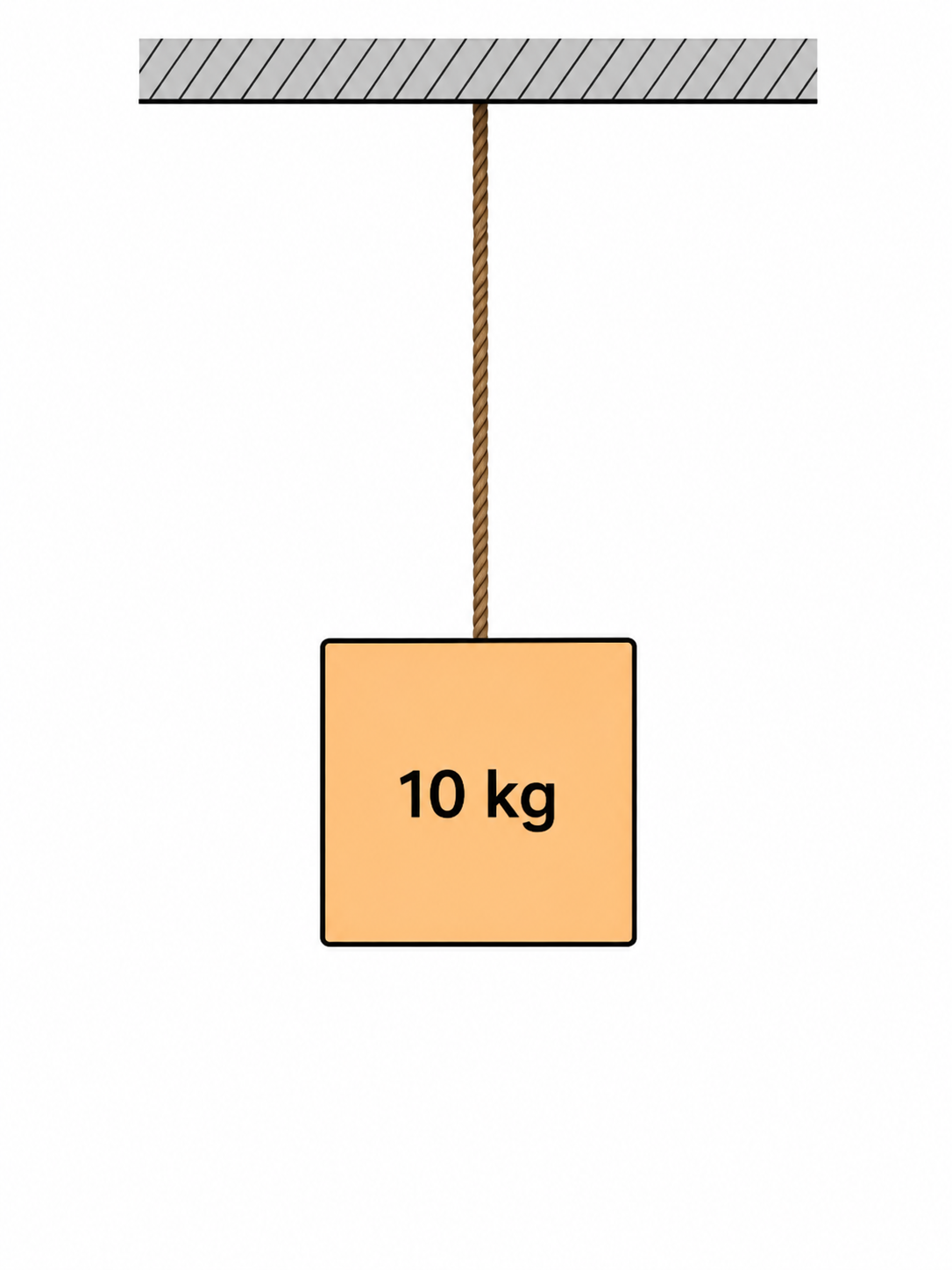
A 10 kg block is hanging at rest from a light vertical string. What is the tension in the string? (Take g = 10 m/s²)
Tension Force <-- Tension Basics
A
T = 0 N
B
T = 10 N
C
T = 100 N
D
T = 1000 N
✅ Show Answer
✔ Correct Answer:
C
(T = 100 N)
💡 Explanation
Given:
Mass of block, m = 10 kg
The block is hanging at rest.
Acceleration due to gravity, g = 10 m/s²
Step 1: Identify the forces acting on the block.
The weight of the block acts vertically downward:
W = mg
The tension in the string acts vertically upward:
T = ?
Step 2: Since the block is at rest, its acceleration is zero.
Therefore, the net force on the block is zero.
So, the upward tension must balance the downward weight:
T = mg
Step 3: Substitute the values.
T = 10 × 10
T = 100 N
Therefore, the tension in the string is:
T = 100 N.
Mass of block, m = 10 kg
The block is hanging at rest.
Acceleration due to gravity, g = 10 m/s²
Step 1: Identify the forces acting on the block.
The weight of the block acts vertically downward:
W = mg
The tension in the string acts vertically upward:
T = ?
Step 2: Since the block is at rest, its acceleration is zero.
Therefore, the net force on the block is zero.
So, the upward tension must balance the downward weight:
T = mg
Step 3: Substitute the values.
T = 10 × 10
T = 100 N
Therefore, the tension in the string is:
T = 100 N.
🎯 Conclusion
How to think about this problem:
1. The block is hanging at rest.
2. At rest means acceleration is zero.
3. Therefore, the net force on the block must be zero.
4. Tension acts upward and weight acts downward.
5. These two forces must be equal in magnitude:
T = mg
For a 10 kg block with g = 10 m/s²:
T = 10 × 10 = 100 N.
Key idea:
For a block hanging at rest from a single vertical string, the tension equals the weight of the block.
Therefore:
T = mg = 100 N.
1. The block is hanging at rest.
2. At rest means acceleration is zero.
3. Therefore, the net force on the block must be zero.
4. Tension acts upward and weight acts downward.
5. These two forces must be equal in magnitude:
T = mg
For a 10 kg block with g = 10 m/s²:
T = 10 × 10 = 100 N.
Key idea:
For a block hanging at rest from a single vertical string, the tension equals the weight of the block.
Therefore:
T = mg = 100 N.
2
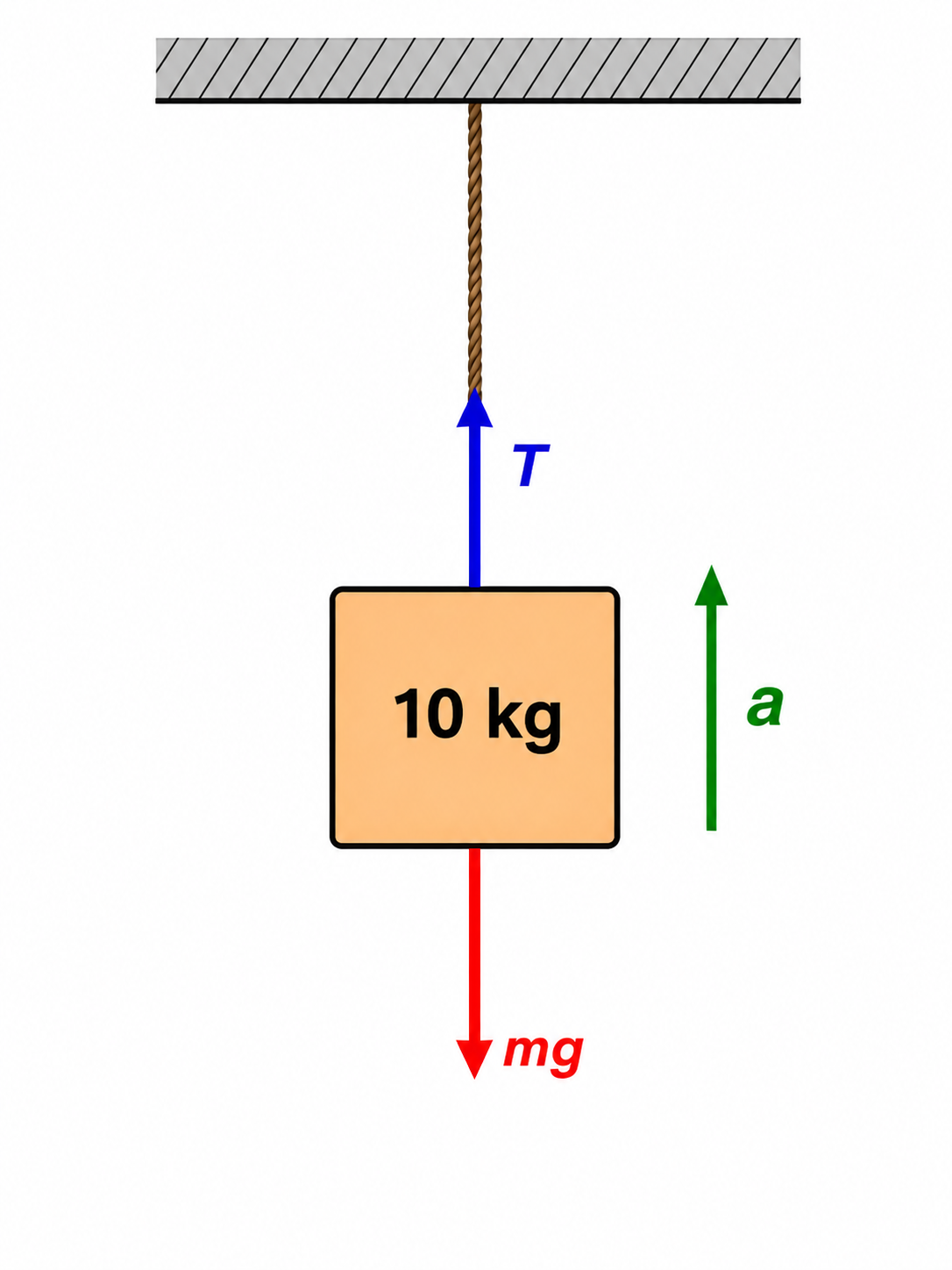
A 10 kg block is hanging from a light vertical string and is accelerating upward at 2 m/s². What is the tension in the string? (Take g = 10 m/s²)
Tension Force <-- Block Accelerating Upward
A
80 N
B
100 N
C
120 N
D
200 N
✅ Show Answer
✔ Correct Answer:
C
(120 N)
💡 Explanation
Given:
Mass of block, m = 10 kg
Acceleration, a = 2 m/s² upward
Acceleration due to gravity, g = 10 m/s²
Step 1: Identify the forces acting on the block.
Tension T acts upward.
Weight mg acts downward.
Step 2: Apply Newton's second law.
Since the block is accelerating upward, the net force is upward.
Taking upward as positive:
T - mg = ma
Step 3: Rearrange the equation to find tension.
T = mg + ma
T = m(g + a)
Step 4: Substitute the values.
T = 10(10 + 2)
T = 10 × 12
T = 120 N
Therefore, the tension in the string is:
T = 120 N.
Mass of block, m = 10 kg
Acceleration, a = 2 m/s² upward
Acceleration due to gravity, g = 10 m/s²
Step 1: Identify the forces acting on the block.
Tension T acts upward.
Weight mg acts downward.
Step 2: Apply Newton's second law.
Since the block is accelerating upward, the net force is upward.
Taking upward as positive:
T - mg = ma
Step 3: Rearrange the equation to find tension.
T = mg + ma
T = m(g + a)
Step 4: Substitute the values.
T = 10(10 + 2)
T = 10 × 12
T = 120 N
Therefore, the tension in the string is:
T = 120 N.
🎯 Conclusion
How to think about this problem:
1. The block is accelerating upward, so the net force must be upward.
2. Tension acts upward and weight acts downward.
3. Therefore, tension must be greater than the weight.
4. Apply Newton's second law:
T - mg = ma
5. Rearranging:
T = m(g + a)
For m = 10 kg, g = 10 m/s², and a = 2 m/s²:
T = 10(10 + 2) = 120 N.
Key idea:
When a hanging block accelerates upward, the tension is greater than its weight.
Therefore:
T = 120 N.
1. The block is accelerating upward, so the net force must be upward.
2. Tension acts upward and weight acts downward.
3. Therefore, tension must be greater than the weight.
4. Apply Newton's second law:
T - mg = ma
5. Rearranging:
T = m(g + a)
For m = 10 kg, g = 10 m/s², and a = 2 m/s²:
T = 10(10 + 2) = 120 N.
Key idea:
When a hanging block accelerates upward, the tension is greater than its weight.
Therefore:
T = 120 N.
3
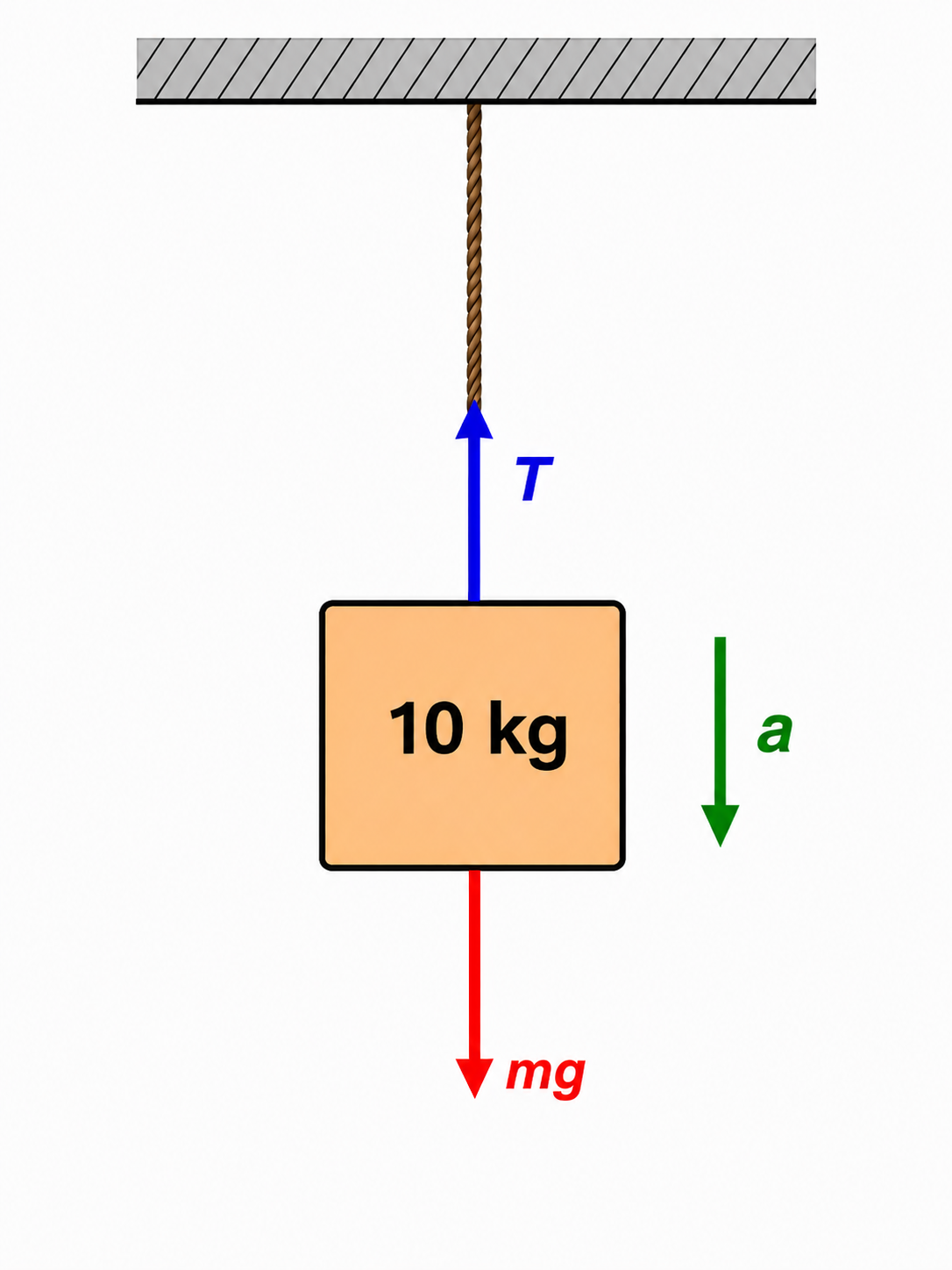
A 10 kg block is hanging from a light vertical string and is accelerating downward at 2 m/s². What is the tension in the string? (Take g = 10 m/s²)
Tension Force <-- Block Accelerating Downward
A
80 N
B
100 N
C
120 N
D
200 N
✅ Show Answer
✔ Correct Answer:
A
(80 N)
💡 Explanation
Given:
Mass of block, m = 10 kg
Acceleration, a = 2 m/s² downward
Acceleration due to gravity, g = 10 m/s²
Step 1: Identify the forces acting on the block.
Tension T acts upward.
Weight mg acts downward.
Step 2: Since the block is accelerating downward, the net force must be downward.
Taking downward as positive:
mg - T = ma
Step 3: Rearrange the equation to find tension.
T = mg - ma
T = m(g - a)
Step 4: Substitute the values.
T = 10(10 - 2)
T = 10 × 8
T = 80 N
Therefore, the tension in the string is:
T = 80 N.
Mass of block, m = 10 kg
Acceleration, a = 2 m/s² downward
Acceleration due to gravity, g = 10 m/s²
Step 1: Identify the forces acting on the block.
Tension T acts upward.
Weight mg acts downward.
Step 2: Since the block is accelerating downward, the net force must be downward.
Taking downward as positive:
mg - T = ma
Step 3: Rearrange the equation to find tension.
T = mg - ma
T = m(g - a)
Step 4: Substitute the values.
T = 10(10 - 2)
T = 10 × 8
T = 80 N
Therefore, the tension in the string is:
T = 80 N.
🎯 Conclusion
How to think about this problem:
1. The block is accelerating downward, so the net force must be downward.
2. Weight acts downward and tension acts upward.
3. Therefore, the weight must be greater than the tension.
4. Apply Newton's second law:
mg - T = ma
5. Rearranging:
T = m(g - a)
For m = 10 kg, g = 10 m/s², and a = 2 m/s²:
T = 10(10 - 2) = 80 N.
Key idea:
When a hanging block accelerates downward, the tension is less than its weight.
Therefore:
T = 80 N.
1. The block is accelerating downward, so the net force must be downward.
2. Weight acts downward and tension acts upward.
3. Therefore, the weight must be greater than the tension.
4. Apply Newton's second law:
mg - T = ma
5. Rearranging:
T = m(g - a)
For m = 10 kg, g = 10 m/s², and a = 2 m/s²:
T = 10(10 - 2) = 80 N.
Key idea:
When a hanging block accelerates downward, the tension is less than its weight.
Therefore:
T = 80 N.
4
A 10 kg block is pulled horizontally by a light string on a smooth horizontal table. The block accelerates at 2 m/s². What is the tension in the string?
Tension Force <-- Horizontal Surface + Tension

A
10 N
B
20 N
C
50 N
D
100 N
✅ Show Answer
✔ Correct Answer:
B
(20 N)
💡 Explanation
Given:
Mass of block, m = 10 kg
Acceleration of block, a = 2 m/s²
The horizontal surface is smooth, so there is no friction.
Step 1: Identify the horizontal forces.
The only horizontal force acting on the block is the tension T.
Step 2: Apply Newton's second law.
Net force = mass × acceleration
Therefore:
T = ma
Step 3: Substitute the values.
T = 10 × 2
T = 20 N
Therefore, the tension in the string is:
T = 20 N.
Mass of block, m = 10 kg
Acceleration of block, a = 2 m/s²
The horizontal surface is smooth, so there is no friction.
Step 1: Identify the horizontal forces.
The only horizontal force acting on the block is the tension T.
Step 2: Apply Newton's second law.
Net force = mass × acceleration
Therefore:
T = ma
Step 3: Substitute the values.
T = 10 × 2
T = 20 N
Therefore, the tension in the string is:
T = 20 N.
🎯 Conclusion
How to think about this problem:
1. The block is on a smooth horizontal surface, so there is no friction.
2. The tension is the only horizontal force acting on the block.
3. The block is accelerating, so the tension produces the acceleration.
4. Apply Newton's second law:
T = ma
For m = 10 kg and a = 2 m/s²:
T = 10 × 2 = 20 N.
Key idea:
When tension is the only horizontal force on a block moving on a smooth surface:
T = ma
Therefore:
T = 20 N.
1. The block is on a smooth horizontal surface, so there is no friction.
2. The tension is the only horizontal force acting on the block.
3. The block is accelerating, so the tension produces the acceleration.
4. Apply Newton's second law:
T = ma
For m = 10 kg and a = 2 m/s²:
T = 10 × 2 = 20 N.
Key idea:
When tension is the only horizontal force on a block moving on a smooth surface:
T = ma
Therefore:
T = 20 N.
5
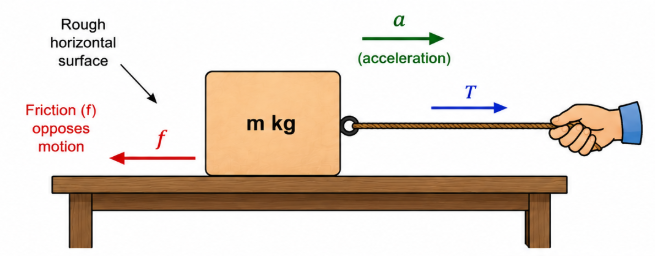
A 10 kg block is pulled horizontally by a string on a rough horizontal surface. The coefficients of static and kinetic friction are both 0.5. If the block accelerates at 2 m/s², what is the tension in the string? (Take g = 10 m/s²)
Tension Force <-- Horizontal Surface + Friction + Tension
A
50 N
B
60 N
C
70 N
D
80 N
✅ Show Answer
✔ Correct Answer:
C
(70 N)
💡 Explanation
Given:
Mass of block, m = 10 kg
Coefficient of static friction, μ_s = 0.5
Coefficient of kinetic friction, μ_k = 0.5
Acceleration, a = 2 m/s²
Acceleration due to gravity, g = 10 m/s²
Step 1: Identify which type of friction acts.
The block is accelerating, so it is sliding relative to the surface.
Therefore, kinetic friction acts.
Important:
We use μ_k, not μ_s.
Step 2: Find the normal reaction.
There is no vertical acceleration, so:
N = mg
N = 10 × 10
N = 100 N
Step 3: Find the kinetic friction.
f_k = μ_kN
f_k = 0.5 × 100
f_k = 50 N
Step 4: Apply Newton's second law horizontally.
Tension acts to the right and friction acts to the left.
Therefore:
T - f_k = ma
Step 5: Substitute the values.
T - 50 = 10 × 2
T - 50 = 20
T = 70 N
Therefore, the tension in the string is:
T = 70 N.
Mass of block, m = 10 kg
Coefficient of static friction, μ_s = 0.5
Coefficient of kinetic friction, μ_k = 0.5
Acceleration, a = 2 m/s²
Acceleration due to gravity, g = 10 m/s²
Step 1: Identify which type of friction acts.
The block is accelerating, so it is sliding relative to the surface.
Therefore, kinetic friction acts.
Important:
We use μ_k, not μ_s.
Step 2: Find the normal reaction.
There is no vertical acceleration, so:
N = mg
N = 10 × 10
N = 100 N
Step 3: Find the kinetic friction.
f_k = μ_kN
f_k = 0.5 × 100
f_k = 50 N
Step 4: Apply Newton's second law horizontally.
Tension acts to the right and friction acts to the left.
Therefore:
T - f_k = ma
Step 5: Substitute the values.
T - 50 = 10 × 2
T - 50 = 20
T = 70 N
Therefore, the tension in the string is:
T = 70 N.
🎯 Conclusion
How to think about this problem:
1. The block is accelerating, so kinetic friction acts.
2. Find the normal force:
N = mg = 100 N.
3. Find kinetic friction:
f_k = μ_kN = 0.5 × 100 = 50 N.
4. Tension pulls the block forward while friction opposes the motion.
5. Apply Newton's second law:
T - f_k = ma.
6. Therefore:
T - 50 = 20
T = 70 N.
Key idea:
When a block accelerates on a rough horizontal surface, use kinetic friction and write:
T - f_k = ma.
Therefore:
T = 70 N.
1. The block is accelerating, so kinetic friction acts.
2. Find the normal force:
N = mg = 100 N.
3. Find kinetic friction:
f_k = μ_kN = 0.5 × 100 = 50 N.
4. Tension pulls the block forward while friction opposes the motion.
5. Apply Newton's second law:
T - f_k = ma.
6. Therefore:
T - 50 = 20
T = 70 N.
Key idea:
When a block accelerates on a rough horizontal surface, use kinetic friction and write:
T - f_k = ma.
Therefore:
T = 70 N.
6
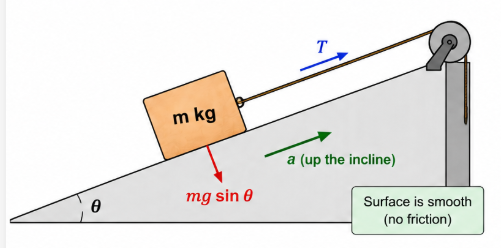
A 10 kg block is pulled up a smooth inclined plane by a string. The angle of inclination is 30°. If the block accelerates up the incline at 2 m/s², what is the tension in the string? (Take g = 10 m/s²)
Tension Force <-- Inclined Plane + Tension
A
50 N
B
60 N
C
70 N
D
80 N
✅ Show Answer
✔ Correct Answer:
C
(70 N)
💡 Explanation
Given:
Mass of block, m = 10 kg
Angle of inclination, θ = 30°
Acceleration of block, a = 2 m/s² upward along the incline
Acceleration due to gravity, g = 10 m/s²
The incline is smooth, so there is no friction.
Step 1: Resolve the weight along the incline.
The component of weight acting down the incline is:
mg sin θ
Step 2: Apply Newton's second law along the incline.
Taking upward along the incline as positive:
T - mg sin θ = ma
Therefore:
T = ma + mg sin θ
Step 3: Calculate the component of weight along the incline.
mg sin θ = 10 × 10 × sin 30°
sin 30° = 1/2
mg sin θ = 100 × 1/2
mg sin θ = 50 N
Step 4: Substitute the values.
T = 10 × 2 + 50
T = 20 + 50
T = 70 N
Therefore, the tension in the string is:
T = 70 N.
Mass of block, m = 10 kg
Angle of inclination, θ = 30°
Acceleration of block, a = 2 m/s² upward along the incline
Acceleration due to gravity, g = 10 m/s²
The incline is smooth, so there is no friction.
Step 1: Resolve the weight along the incline.
The component of weight acting down the incline is:
mg sin θ
Step 2: Apply Newton's second law along the incline.
Taking upward along the incline as positive:
T - mg sin θ = ma
Therefore:
T = ma + mg sin θ
Step 3: Calculate the component of weight along the incline.
mg sin θ = 10 × 10 × sin 30°
sin 30° = 1/2
mg sin θ = 100 × 1/2
mg sin θ = 50 N
Step 4: Substitute the values.
T = 10 × 2 + 50
T = 20 + 50
T = 70 N
Therefore, the tension in the string is:
T = 70 N.
🎯 Conclusion
How to think about this problem:
1. The incline is smooth, so there is no friction.
2. The component of the block's weight acting down the incline is:
mg sin θ.
3. Tension acts up the incline.
4. Since the block accelerates up the incline:
T - mg sin θ = ma.
5. Therefore:
T = ma + mg sin θ.
For m = 10 kg, a = 2 m/s², g = 10 m/s², and θ = 30°:
T = 10(2) + 10(10)(1/2)
T = 20 + 50
T = 70 N.
Key idea:
On a smooth inclined plane, the component of weight acting down the incline is mg sin θ. Always resolve the weight before applying Newton's second law along the incline.
Therefore:
T = 70 N.
1. The incline is smooth, so there is no friction.
2. The component of the block's weight acting down the incline is:
mg sin θ.
3. Tension acts up the incline.
4. Since the block accelerates up the incline:
T - mg sin θ = ma.
5. Therefore:
T = ma + mg sin θ.
For m = 10 kg, a = 2 m/s², g = 10 m/s², and θ = 30°:
T = 10(2) + 10(10)(1/2)
T = 20 + 50
T = 70 N.
Key idea:
On a smooth inclined plane, the component of weight acting down the incline is mg sin θ. Always resolve the weight before applying Newton's second law along the incline.
Therefore:
T = 70 N.
7
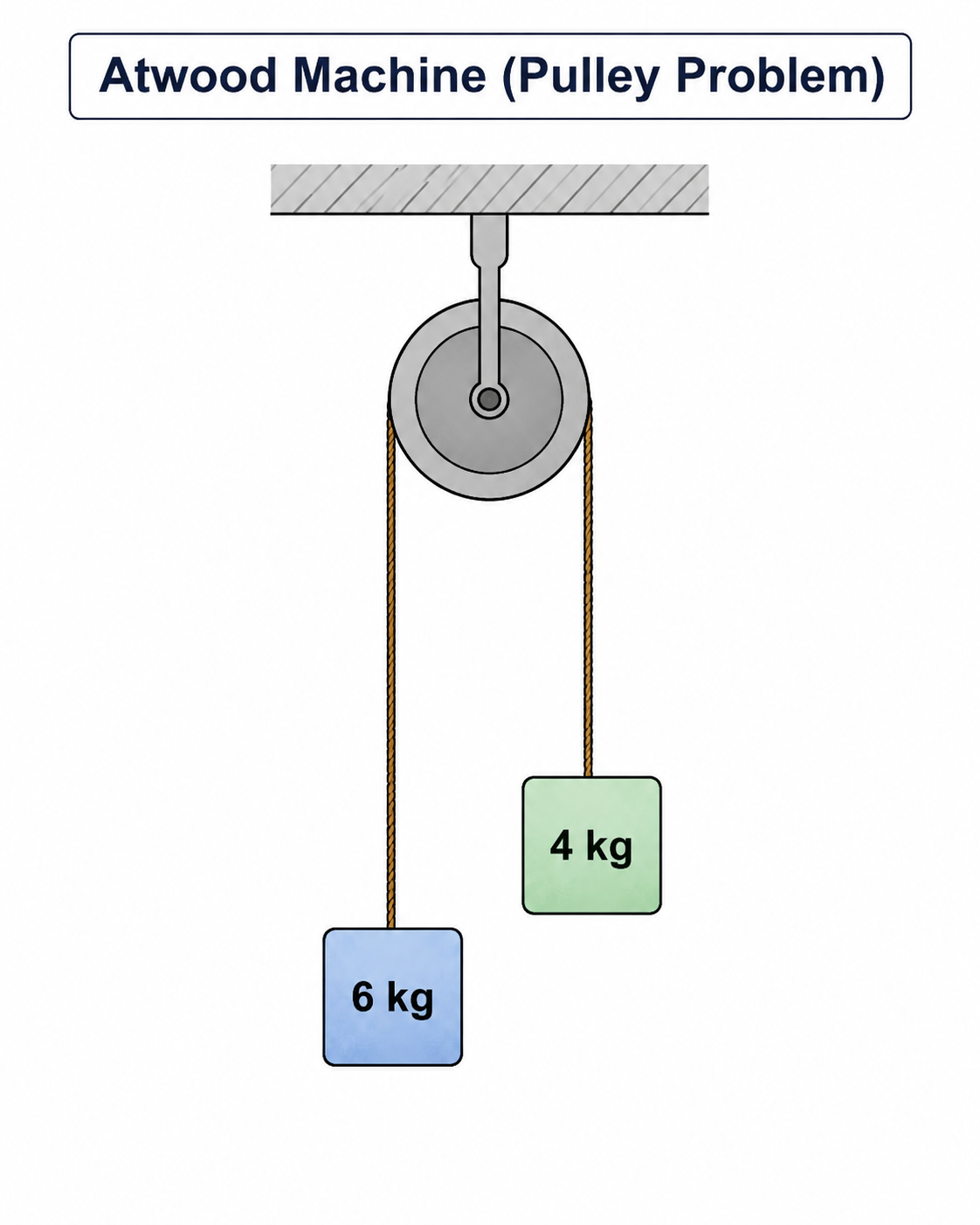
Two blocks of masses 6 kg and 4 kg are connected by a light, inextensible string passing over a frictionless pulley. If the 6 kg block moves downward, what is the tension in the string? (Take g = 10 m/s²)
Tension Force <-- Pulley Problems — Atwood Machine
A
40 N
B
48 N
C
50 N
D
60 N
✅ Show Answer
✔ Correct Answer:
B
(48 N)
💡 Explanation
Given:
Mass of heavier block, m₁ = 6 kg
Mass of lighter block, m₂ = 4 kg
Acceleration due to gravity, g = 10 m/s²
The string is light and inextensible.
The pulley is frictionless.
Step 1: Find the acceleration of the system.
The 6 kg block is heavier, so it moves downward and the 4 kg block moves upward.
For the complete system:
a = (m₁ - m₂)g / (m₁ + m₂)
Substitute the values:
a = (6 - 4) × 10 / (6 + 4)
a = 20 / 10
a = 2 m/s²
Step 2: Find the tension using the 4 kg block.
The 4 kg block accelerates upward, so:
T - m₂g = m₂a
Therefore:
T = m₂(g + a)
Step 3: Substitute the values.
T = 4(10 + 2)
T = 4 × 12
T = 48 N
Therefore, the tension in the string is:
T = 48 N.
Mass of heavier block, m₁ = 6 kg
Mass of lighter block, m₂ = 4 kg
Acceleration due to gravity, g = 10 m/s²
The string is light and inextensible.
The pulley is frictionless.
Step 1: Find the acceleration of the system.
The 6 kg block is heavier, so it moves downward and the 4 kg block moves upward.
For the complete system:
a = (m₁ - m₂)g / (m₁ + m₂)
Substitute the values:
a = (6 - 4) × 10 / (6 + 4)
a = 20 / 10
a = 2 m/s²
Step 2: Find the tension using the 4 kg block.
The 4 kg block accelerates upward, so:
T - m₂g = m₂a
Therefore:
T = m₂(g + a)
Step 3: Substitute the values.
T = 4(10 + 2)
T = 4 × 12
T = 48 N
Therefore, the tension in the string is:
T = 48 N.
🎯 Conclusion
How to think about this problem:
1. The 6 kg block is heavier, so it moves downward.
2. The 4 kg block moves upward with the same acceleration magnitude.
3. For an ideal string and frictionless pulley, the tension is the same throughout the string.
4. First find the common acceleration:
a = (m₁ - m₂)g / (m₁ + m₂)
a = 2 m/s².
5. For the 4 kg block:
T - m₂g = m₂a
Therefore:
T = m₂(g + a)
T = 4(10 + 2)
T = 48 N.
Key idea:
In an ideal Atwood machine, both masses have the same acceleration magnitude and the tension is the same throughout the string.
Therefore:
T = 48 N.
1. The 6 kg block is heavier, so it moves downward.
2. The 4 kg block moves upward with the same acceleration magnitude.
3. For an ideal string and frictionless pulley, the tension is the same throughout the string.
4. First find the common acceleration:
a = (m₁ - m₂)g / (m₁ + m₂)
a = 2 m/s².
5. For the 4 kg block:
T - m₂g = m₂a
Therefore:
T = m₂(g + a)
T = 4(10 + 2)
T = 48 N.
Key idea:
In an ideal Atwood machine, both masses have the same acceleration magnitude and the tension is the same throughout the string.
Therefore:
T = 48 N.
8
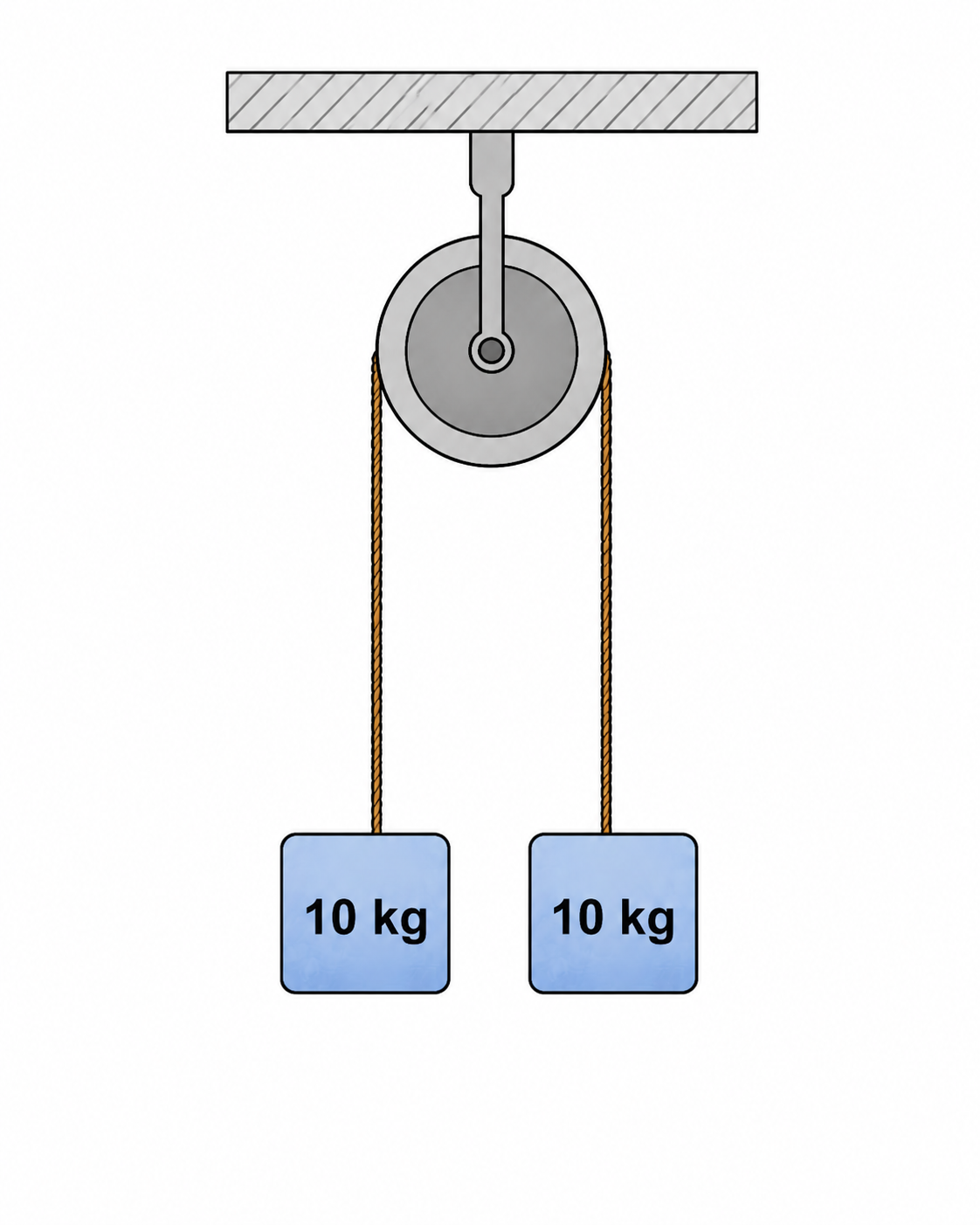
Two blocks of masses 10 kg and 10 kg are connected by a light, inextensible string passing over a frictionless pulley. What is the tension in the string? (Take g = 10 m/s²)
Tension Force <-- Pulley Problems — Equal Masses
A
0 N
B
50 N
C
100 N
D
200 N
✅ Show Answer
✔ Correct Answer:
C
(100 N)
💡 Explanation
Given:
Mass of first block, m₁ = 10 kg
Mass of second block, m₂ = 10 kg
Acceleration due to gravity, g = 10 m/s²
The string is light and inextensible.
The pulley is frictionless.
Step 1: Compare the two masses.
Both masses are equal:
m₁ = m₂ = 10 kg
Therefore, neither block is heavier than the other.
There is no unbalanced force to produce acceleration.
Hence:
a = 0 m/s²
Step 2: Consider either block.
For the 10 kg block, tension acts upward and weight acts downward.
Since the block has zero acceleration:
T - mg = 0
Therefore:
T = mg
Step 3: Substitute the values.
T = 10 × 10
T = 100 N
Therefore, the tension in the string is:
T = 100 N.
Mass of first block, m₁ = 10 kg
Mass of second block, m₂ = 10 kg
Acceleration due to gravity, g = 10 m/s²
The string is light and inextensible.
The pulley is frictionless.
Step 1: Compare the two masses.
Both masses are equal:
m₁ = m₂ = 10 kg
Therefore, neither block is heavier than the other.
There is no unbalanced force to produce acceleration.
Hence:
a = 0 m/s²
Step 2: Consider either block.
For the 10 kg block, tension acts upward and weight acts downward.
Since the block has zero acceleration:
T - mg = 0
Therefore:
T = mg
Step 3: Substitute the values.
T = 10 × 10
T = 100 N
Therefore, the tension in the string is:
T = 100 N.
🎯 Conclusion
How to think about this problem:
1. Both blocks have the same mass, so neither block pulls the other downward.
2. Therefore, the system has zero acceleration.
3. Each block is in equilibrium.
4. For either block:
T = mg
5. For a 10 kg block:
T = 10 × 10 = 100 N.
Key idea:
When two equal masses are connected in an ideal Atwood machine, the system has zero acceleration and the tension equals the weight of either block.
Therefore:
T = 100 N.
1. Both blocks have the same mass, so neither block pulls the other downward.
2. Therefore, the system has zero acceleration.
3. Each block is in equilibrium.
4. For either block:
T = mg
5. For a 10 kg block:
T = 10 × 10 = 100 N.
Key idea:
When two equal masses are connected in an ideal Atwood machine, the system has zero acceleration and the tension equals the weight of either block.
Therefore:
T = 100 N.