2. Biological Classification
1

Since the dawn of civilisation, there have been many attempts to classify living organisms.

πŸ‘‰ Since the dawn of civilisation – From the very beginning of human civilisation, when people first started living in organized societies, they began observing the living world around them.

πŸ‘‰ There have been many attempts – Throughout history, different people and scientists have tried various methods to group and organize living organisms. As scientific knowledge increased, these methods became more accurate.

πŸ‘‰ To classify living organisms – Classification means arranging living organisms into different groups based on their similarities and differences. This makes it easier to identify, study, compare, and understand the enormous diversity of life.

πŸ‘‰ Overall meaning – Humans have been trying to classify living organisms since the beginning of civilisation, and these classification systems have continuously improved with the advancement of science.

2

It was done instinctively, not using criteria that were scientific but borne out of a need to use organisms for our own use – for food, shelter and clothing.

πŸ‘‰ It was done instinctively – Early humans classified living organisms naturally based on their day-to-day experiences, without any scientific knowledge or systematic study.

πŸ‘‰ Not using criteria that were scientific – They did not use scientific features such as body structure, cell type, mode of nutrition, reproduction, evolution, or genetic relationships to classify organisms.

πŸ‘‰ But borne out of a need – The main reason for classification was survival. People grouped organisms because they needed them in their daily lives, not because they wanted to study biology.

πŸ‘‰ To use organisms for our own use – Organisms were classified according to how useful they were to humans, such as whether they could provide food, medicine, fuel, or other useful materials.

πŸ‘‰ For food – Edible plants, fruits, vegetables, grains, fish, birds, and animals were recognized and grouped because they served as sources of food.

πŸ‘‰ For shelter – Trees, bamboo, grasses, and other plants that provided wood or building materials were identified because they helped people build houses and protect themselves from the environment.

πŸ‘‰ For clothing – Plants and animals that provided fibres or materials, such as cotton, flax, sheep (wool), and silkworms (silk), were grouped because they were useful for making clothes.

πŸ‘‰ Overall meaning – The earliest classification of living organisms was based on human needs and practical usefulness rather than on scientific principles or natural relationships among organisms.

3

Aristotle was the earliest to attempt a more scientific basis for classification.

πŸ‘‰ Aristotle – Aristotle was a famous Greek philosopher and biologist who lived from 384–322 BC. He is regarded as one of the earliest scientists to study living organisms systematically.

πŸ‘‰ Was the earliest – Among the early scholars, Aristotle was one of the first to develop a systematic method of classifying living organisms instead of relying only on their usefulness.

πŸ‘‰ To attempt – He made an effort to organize living organisms in a logical and systematic way, although his classification was not perfect by modern standards.

πŸ‘‰ A more scientific basis – He classified organisms using observable characteristics such as body structure, habitat (land, water, air), and the presence or absence of blood, rather than only their use to humans.

πŸ‘‰ For classification – His work laid the foundation for scientific classification, inspiring later scientists to develop more accurate and advanced classification systems.

πŸ‘‰ Overall meaning – Aristotle was the first person to make a systematic and relatively scientific attempt to classify living organisms based on their observable characteristics.

4

He used simple morphological characters to classify plants into trees, shrubs and herbs.

πŸ‘‰ He used – Aristotle classified plants by observing their visible features instead of using complex scientific techniques.

πŸ‘‰ Simple morphological characters – He used easily observable external features (morphology), such as the size, shape, height, and nature of the stem, to distinguish different kinds of plants.

πŸ‘‰ To classify plants – He grouped plants that shared similar external characteristics into the same category, making them easier to identify and study.

πŸ‘‰ Trees – Tall, woody plants with a single thick trunk that live for many years. Examples: Mango, Neem, Banyan.

πŸ‘‰ Shrubs – Medium-sized woody plants with several branches arising near the base. Examples: Rose, Hibiscus, Cotton.

πŸ‘‰ Herbs – Small plants with soft, green, and non-woody stems. They usually have a short life span. Examples: Spinach, Mint, Coriander.

πŸ‘‰ Overall meaning – Aristotle classified plants into trees, shrubs, and herbs based on simple external features, especially the nature of their stem and overall size.

5

He also divided animals into two groups, those which had red blood and those that did not.

πŸ‘‰ He also divided animals – Besides classifying plants, Aristotle also grouped animals using easily observable physical characteristics.

πŸ‘‰ Into two groups – He placed all animals into two main categories based on the presence or absence of red blood.

πŸ‘‰ Those which had red blood – These animals possessed red blood and generally had a backbone. This group roughly corresponds to modern vertebrates, such as fishes, amphibians, reptiles, birds, and mammals.

πŸ‘‰ Those that did not – These animals did not appear to have red blood. This group roughly corresponds to modern invertebrates, such as insects, worms, snails, jellyfish, and starfish.

πŸ‘‰ Red blood – Aristotle used the visible red colour of blood as a simple characteristic for classification. He did not know about cells, haemoglobin, or the circulatory system as understood today.

πŸ‘‰ Overall meaning – Aristotle classified animals into two broad groups based on whether they had visible red blood. Although simple, this was one of the earliest scientific attempts to classify animals and later evolved into the modern concepts of vertebrates and invertebrates.

6

In Linnaeus’ time a Two Kingdom system of classification with Plantae and Animalia kingdoms was developed that included all plants and animals respectively.

πŸ‘‰ In Linnaeus' time – During the 18th century, when Carolus Linnaeus (1707–1778) lived, scientists developed a more organized and scientific system for classifying living organisms.

πŸ‘‰ A Two Kingdom system of classification – Linnaeus divided all living organisms into only two major kingdoms. At that time, this was considered the simplest and most scientific method of classification.

πŸ‘‰ Plantae Kingdom – The kingdom Plantae included all plants. These organisms were generally green, fixed in one place, and capable of preparing their own food through photosynthesis.

πŸ‘‰ Animalia Kingdom – The kingdom Animalia included all animals. These organisms were generally capable of movement and depended on other organisms for food.

πŸ‘‰ Included all plants and animals respectively – Every known plant was placed in the Kingdom Plantae, and every known animal was placed in the Kingdom Animalia. No other kingdoms existed in this classification system.

πŸ‘‰ Overall meaning – Linnaeus introduced the Two Kingdom Classification System, in which all living organisms were grouped into only two kingdoms: Plantae for plants and Animalia for animals.

7

This system did not distinguish between the eukaryotes and prokaryotes, unicellular and multicellular organisms, and photosynthetic (green algae) and non-photosynthetic (fungi) organisms.

πŸ‘‰ This system did not distinguish – The Two Kingdom Classification System could not clearly separate organisms based on their fundamental biological characteristics. Many different kinds of organisms were incorrectly placed in the same kingdom.

πŸ‘‰ Between the eukaryotes and prokaryotes – It did not separate organisms with a true nucleus and membrane-bound organelles (eukaryotes) from those without a true nucleus and membrane-bound organelles (prokaryotes). As a result, bacteria and higher plants were not recognized as fundamentally different.

πŸ‘‰ Unicellular and multicellular organisms – It did not distinguish between organisms made up of a single cell (unicellular) and those made up of many cells (multicellular). For example, unicellular algae and large multicellular plants were grouped together.

πŸ‘‰ Photosynthetic organisms (green algae) – Green algae can prepare their own food by photosynthesis because they contain chlorophyll. However, they were simply placed in the plant kingdom without considering other important characteristics.

πŸ‘‰ Non-photosynthetic organisms (fungi) – Fungi cannot prepare their own food because they lack chlorophyll. They obtain nutrients from other organisms, yet they were also placed in the plant kingdom, even though they are very different from plants.

πŸ‘‰ Overall meaning – The Two Kingdom Classification System had several limitations because it failed to distinguish between prokaryotes and eukaryotes, unicellular and multicellular organisms, and photosynthetic organisms like green algae and non-photosynthetic organisms like fungi.

8

Classification of organisms into plants and animals was easily done and was easy to understand, but a large number of organisms did not fall into either category.

πŸ‘‰ Classification of organisms into plants and animals – In the Two Kingdom Classification System, all living organisms were grouped into only two kingdoms: Plantae (plants) and Animalia (animals).

πŸ‘‰ Was easily done – Since there were only two kingdoms, classifying most familiar organisms was simple and straightforward.

πŸ‘‰ Was easy to understand – The system was simple enough for people to learn and use because every organism was expected to belong to either the plant kingdom or the animal kingdom.

πŸ‘‰ But a large number of organisms – As scientists discovered more living organisms, they found many species with characteristics that were different from both plants and animals.

πŸ‘‰ Did not fall into either category – Many organisms could not be placed correctly in either the plant kingdom or the animal kingdom because they possessed unique features. For example, bacteria are prokaryotic, fungi lack chlorophyll and absorb nutrients, and protists show characteristics different from both plants and animals.

πŸ‘‰ Overall meaning – Although the Two Kingdom Classification System was simple and easy to understand, it could not accurately classify many organisms because they did not fit completely into either the plant kingdom or the animal kingdom.

9

Hence the two kingdom classification used for a long time was found inadequate.

πŸ‘‰ Hence – Therefore, because of the many limitations of the Two Kingdom Classification System, scientists realized that a better system was needed.

πŸ‘‰ The Two Kingdom Classification – This was the classification system introduced by Linnaeus, in which all living organisms were placed into only two kingdoms: Plantae and Animalia.

πŸ‘‰ Used for a long time – This system remained in use for many years because it was simple, easy to understand, and suitable for the organisms known at that time.

πŸ‘‰ Was found inadequate – As more organisms were discovered and scientific knowledge advanced, scientists realized that this system could not accurately classify all living organisms. It failed to distinguish between prokaryotes and eukaryotes, unicellular and multicellular organisms, and photosynthetic and non-photosynthetic organisms. Therefore, it was considered incomplete and insufficient.

πŸ‘‰ Overall meaning – Because the Two Kingdom Classification System had several limitations and could not correctly classify many organisms, scientists concluded that it was inadequate and developed more advanced classification systems, such as the Five Kingdom Classification.

10

Besides gross morphology, a need was also felt for including other characteristics like cell structure, nature of wall, mode of nutrition, habitat, methods of reproduction, evolutionary relationships, etc.

πŸ‘‰ Besides gross morphology – Scientists realized that classifying organisms based only on their external appearance (such as size, shape, colour, leaves, stems, or body form) was not enough. Many organisms look similar externally but are very different internally.

πŸ‘‰ A need was also felt – As biological knowledge increased, scientists understood that a more accurate and scientific classification system was necessary.

πŸ‘‰ For including other characteristics – They decided that classification should be based on several important characteristics instead of only external features.

πŸ‘‰ Cell structure – Scientists considered whether an organism is prokaryotic (without a true nucleus) or eukaryotic (with a true nucleus and membrane-bound organelles).

πŸ‘‰ Nature of wall – They examined the cell wall, including whether it is present or absent and what it is made of, such as cellulose in plants, chitin in fungi, or peptidoglycan in bacteria.

πŸ‘‰ Mode of nutrition – Organisms were classified according to how they obtain food, such as autotrophic (making their own food), heterotrophic (obtaining food from others), saprophytic, or parasitic.

πŸ‘‰ Habitat – Scientists also considered the natural place where an organism lives, such as land, water, air, or inside another organism.

πŸ‘‰ Methods of reproduction – Classification also depended on how organisms produce offspring, such as asexual reproduction (binary fission, budding, spores) or sexual reproduction.

πŸ‘‰ Evolutionary relationships – Scientists studied how different organisms are related through evolution and whether they share a common ancestor. Organisms with closer evolutionary relationships were placed in the same group.

πŸ‘‰ Overall meaning – Scientists realized that accurate classification requires considering many characteristics, such as cell structure, cell wall, nutrition, habitat, reproduction, and evolutionary relationships, rather than relying only on external appearance.

11

Classification systems for the living organisms have, hence, undergone several changes over time.

πŸ‘‰ Classification systems for living organisms – These are scientific methods used to group living organisms based on their similarities, differences, and natural relationships.

πŸ‘‰ Have, hence – Therefore, because earlier classification systems had many limitations, scientists developed improved systems.

πŸ‘‰ Undergone several changes – Classification has been revised many times as new discoveries were made. Scientists continuously modified and improved the system to make it more accurate.

πŸ‘‰ Over time – As science and technology advanced over hundreds of years, new information about cells, genetics, evolution, and microorganisms became available, leading to better classification methods.

πŸ‘‰ Examples of these changes – The classification system evolved from:
β€’ Early human classification based on usefulness
β€’ Aristotle's scientific classification
β€’ Linnaeus' Two Kingdom Classification
β€’ Three Kingdom Classification
β€’ Four Kingdom Classification
β€’ Five Kingdom Classification (Whittaker)
β€’ Six Kingdom and Three Domain Classification systems used today.

πŸ‘‰ Overall meaning – Since scientific knowledge has continuously increased, classification systems have also changed and improved over time to reflect a more accurate understanding of the relationships among living organisms.

12

Though plant and animal kingdoms have been a constant under all different systems, the understanding of what groups/organisms be included under these kingdoms have been changing; the number and nature of other kingdoms have also been understood differently by different scientists over time.

πŸ‘‰ Though plant and animal kingdoms have been a constant – In every major classification system, the kingdoms Plantae and Animalia have always existed. They have remained an essential part of biological classification.

πŸ‘‰ Under all different systems – Whether it was the Two Kingdom, Three Kingdom, Four Kingdom, Five Kingdom, or Six Kingdom Classification System, the plant and animal kingdoms were always included.

πŸ‘‰ The understanding of what groups/organisms be included under these kingdoms has been changing – As scientific knowledge improved, scientists realized that some organisms previously placed in Plantae or Animalia actually belonged to different kingdoms. For example, fungi were once considered plants but later placed in the Kingdom Fungi, and many microorganisms were moved to the Kingdom Protista or Monera.

πŸ‘‰ The number of other kingdoms – Scientists did not always agree on how many kingdoms should exist. Some proposed Three Kingdoms, others Four, Five, or Six Kingdoms, depending on the available scientific evidence.

πŸ‘‰ The nature of other kingdoms – Scientists also differed in deciding which organisms should be grouped together and what characteristics should define each kingdom. As new discoveries were made, the features and boundaries of these kingdoms were revised.

πŸ‘‰ Have also been understood differently by different scientists over time – Different scientists developed different classification systems based on the scientific knowledge available during their time. As research in cell biology, genetics, and evolution advanced, classification systems became more accurate.

πŸ‘‰ Overall meaning – Although the Plant and Animal Kingdoms remained part of every classification system, scientists continuously changed which organisms belonged to these kingdoms and also revised the number and characteristics of the other kingdoms as scientific knowledge improved.

13

R.H. Whittaker (1969) proposed a Five Kingdom Classification. The kingdoms defined by him were named Monera, Protista, Fungi, Plantae and Animalia.

R.H. Whittaker (1969) proposed a Five Kingdom Classification. The kingdoms defined by him were named Monera, Protista, Fungi, Plantae and Animalia.

πŸ‘‰ R.H. Whittaker (1969) – Robert H. Whittaker was an American ecologist who, in 1969, introduced a new and more scientific system for classifying living organisms.

πŸ‘‰ Proposed – He suggested and introduced a new classification system based on scientific evidence and the latest biological knowledge available at that time.

πŸ‘‰ A Five Kingdom Classification – Instead of placing all organisms into only two kingdoms, Whittaker divided all living organisms into five separate kingdoms, making classification more natural and accurate.

πŸ‘‰ The kingdoms defined by him – Whittaker clearly identified and described five major groups of living organisms, each having its own unique characteristics.

πŸ‘‰ Monera – This kingdom includes prokaryotic, unicellular organisms that lack a true nucleus and membrane-bound organelles. Examples: Bacteria and Cyanobacteria.

πŸ‘‰ Protista – This kingdom includes eukaryotic, mostly unicellular organisms. Examples: Amoeba, Paramecium, Euglena, and Diatoms.

πŸ‘‰ Fungi – This kingdom includes eukaryotic, non-photosynthetic organisms that absorb nutrients from dead or living organisms. Their cell wall is made of chitin. Examples: Mushroom, Yeast, and Rhizopus.

πŸ‘‰ Plantae – This kingdom includes multicellular, photosynthetic eukaryotes with cell walls made of cellulose. Examples: Mango, Neem, Ferns, and Mosses.

πŸ‘‰ Animalia – This kingdom includes multicellular, heterotrophic eukaryotes that lack a cell wall and usually show movement. Examples: Humans, Fish, Birds, and Insects.

πŸ‘‰ Overall meaning – In 1969, R.H. Whittaker introduced the Five Kingdom Classification System, dividing all living organisms into Monera, Protista, Fungi, Plantae, and Animalia. This system was more scientific and overcame many limitations of the earlier Two Kingdom Classification.

14

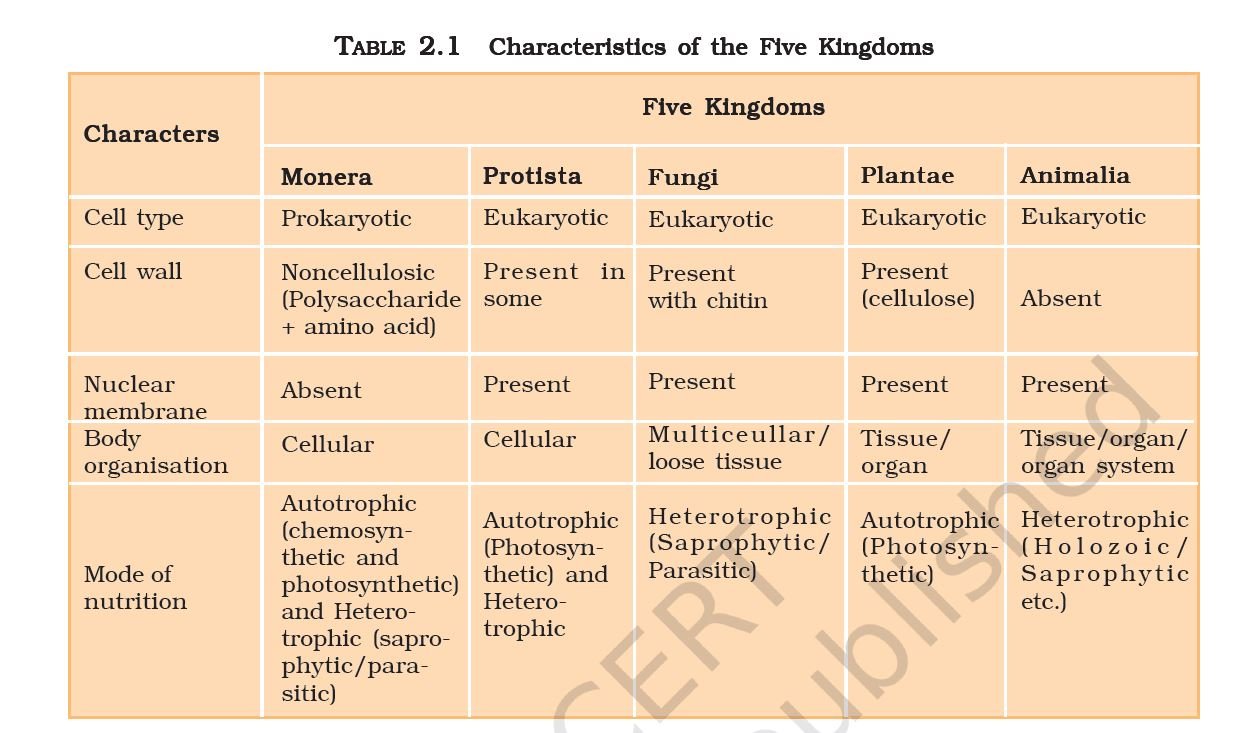
The main criteria for classification used by him include cell structure, body organisation, mode of nutrition, reproduction and phylogenetic relationships. Table 2.1 gives a comparative account of different characteristics of the five kingdoms.

πŸ‘‰ The main criteria for classification – R.H. Whittaker used several important biological characteristics (criteria) to classify living organisms more accurately. Instead of relying only on external appearance, he considered both structural and functional features.

πŸ‘‰ Used by him – These criteria were chosen by R.H. Whittaker while proposing the Five Kingdom Classification in 1969.

πŸ‘‰ Cell structure – He examined the type of cells present in an organism. Organisms were classified as prokaryotic (without a true nucleus and membrane-bound organelles) or eukaryotic (with a true nucleus and membrane-bound organelles).

πŸ‘‰ Body organisation – He considered how the body of an organism is organized, whether it is unicellular (made of a single cell) or multicellular (made of many specialized cells forming tissues and organs).

πŸ‘‰ Mode of nutrition – He classified organisms according to how they obtain food, such as autotrophic (making their own food by photosynthesis or chemosynthesis) or heterotrophic (obtaining food from other organisms by ingestion or absorption).

πŸ‘‰ Reproduction – He also considered the method by which organisms produce offspring, such as asexual reproduction (binary fission, budding, spore formation) or sexual reproduction (fusion of male and female gametes).

πŸ‘‰ Phylogenetic relationships – He studied the evolutionary history of organisms and their common ancestry. Organisms that evolved from a common ancestor and share closer evolutionary relationships were placed in the same kingdom.

πŸ‘‰ Overall meaning – Whittaker's Five Kingdom Classification was based on five major criteria: cell structure, body organisation, mode of nutrition, reproduction, and evolutionary (phylogenetic) relationships. These criteria made his classification much more scientific and accurate than earlier systems.

15

The three-domain system has also been proposed that divides the Kingdom Monera into two domains, leaving the remaining eukaryotic kingdoms in the third domain and thereby a six kingdom classification.

πŸ‘‰ The three-domain system has also been proposed – Scientists later proposed an even more advanced classification system called the Three-Domain System, which is based mainly on differences in genetic material (especially rRNA) and cell structure.

πŸ‘‰ Divides the Kingdom Monera into two domains – In Whittaker's Five Kingdom Classification, all prokaryotic organisms were placed in a single kingdom called Monera. Later, scientists discovered that Monera actually contains two very different groups, so it was divided into two separate domains:
β€’ Bacteria – True bacteria.
β€’ Archaea – Ancient prokaryotes that differ from bacteria in their cell wall, membrane, and genetic characteristics.

πŸ‘‰ Leaving the remaining eukaryotic kingdoms in the third domain – The other four kingdoms (Protista, Fungi, Plantae, and Animalia) are all composed of eukaryotic organisms. Therefore, they are placed together in the third domain called Eukarya.

πŸ‘‰ Thereby a six kingdom classification – Since Monera is split into two kingdoms (Archaebacteria and Eubacteria), the total number of kingdoms becomes six:
1. Archaebacteria
2. Eubacteria
3. Protista
4. Fungi
5. Plantae
6. Animalia

πŸ‘‰ Three Domains – The three domains in this system are:
β€’ Archaea – Contains Archaebacteria.
β€’ Bacteria – Contains Eubacteria.
β€’ Eukarya – Contains Protista, Fungi, Plantae, and Animalia.

πŸ‘‰ Overall meaning – The Three-Domain System is a more advanced classification than Whittaker's Five Kingdom System. It separates the Kingdom Monera into Archaea and Bacteria, while placing all eukaryotic kingdoms under the domain Eukarya, resulting in a Six Kingdom Classification.

16

Let us look at this Five Kingdom Classification to understand the issues and considerations that influenced the classification system.

πŸ‘‰ Let us look at this Five Kingdom Classification – Now, let us study Whittaker's Five Kingdom Classification in detail to understand how living organisms are grouped into different kingdoms.

πŸ‘‰ To understand the issues – We will learn about the problems and limitations of the earlier classification systems that made scientists search for a better and more accurate method of classification.

πŸ‘‰ And considerations – We will also study the important scientific factors (criteria) that scientists considered while classifying organisms, such as cell structure, body organisation, mode of nutrition, reproduction, and evolutionary relationships.

πŸ‘‰ That influenced the classification system – These problems and scientific criteria guided R.H. Whittaker in developing the Five Kingdom Classification. They helped determine how organisms should be grouped based on their natural characteristics and evolutionary relationships.

πŸ‘‰ Overall meaning – The following sections explain Whittaker's Five Kingdom Classification and the scientific reasons behind it, helping us understand why this system is more accurate than the earlier classification systems.

17

Earlier classification systems included bacteria, blue-green algae, fungi, mosses, ferns, gymnosperms and the angiosperms under 'Plants'.

πŸ‘‰ Earlier classification systems – The early classification systems, especially the Two Kingdom Classification, recognized only two kingdoms: Plantae and Animalia. At that time, scientific knowledge about microorganisms and cell structure was limited.

πŸ‘‰ Included bacteria – Bacteria were placed in the Plant Kingdom because they were thought to be simple plants. Later, scientists discovered that bacteria are prokaryotic organisms without a true nucleus, so they were moved to the Kingdom Monera.

πŸ‘‰ Blue-green algae – Blue-green algae (now called Cyanobacteria) were also included under plants because they perform photosynthesis. Later, they were found to be prokaryotes and were also placed in the Kingdom Monera.

πŸ‘‰ Fungi – Fungi were once considered plants because they are fixed in one place and possess a cell wall. Later, scientists discovered that fungi lack chlorophyll, cannot perform photosynthesis, and absorb nutrients from other organisms. Therefore, they were placed in a separate Kingdom Fungi.

πŸ‘‰ Mosses – Mosses are small, non-flowering, photosynthetic plants belonging to the group Bryophyta. They are true members of the Kingdom Plantae.

πŸ‘‰ Ferns – Ferns are vascular, seedless plants belonging to the group Pteridophyta. They are also correctly placed in the Kingdom Plantae.

πŸ‘‰ Gymnosperms – Gymnosperms are seed-producing plants with naked seeds that are not enclosed within fruits. Examples include Cycas and Pinus. They belong to the Kingdom Plantae.

πŸ‘‰ Angiosperms – Angiosperms are flowering plants whose seeds are enclosed within fruits. They are the largest group of plants and belong to the Kingdom Plantae.

πŸ‘‰ Under 'Plants' – Earlier scientists grouped all these organisms together because they were generally non-motile and many possessed cell walls. Later scientific discoveries showed that bacteria, cyanobacteria, and fungi are fundamentally different from true plants.

πŸ‘‰ Overall meaning – In the early classification systems, many different organisms such as bacteria, blue-green algae, fungi, mosses, ferns, gymnosperms, and angiosperms were all placed in the Plant Kingdom. With advances in biology, bacteria and blue-green algae were moved to Monera, fungi to the Fungi kingdom, while mosses, ferns, gymnosperms, and angiosperms remained in the Kingdom Plantae.

18

The character that unified this whole kingdom was that all the organisms included had a cell wall in their cells.

πŸ‘‰ The character that unified this whole kingdom – The common feature that brought all these different organisms together into the Plant Kingdom was the presence of a cell wall. Scientists believed that this single characteristic was enough to place them in the same kingdom.

πŸ‘‰ Unified – 'Unified' means joined together or grouped into one kingdom because they shared a common characteristic.

πŸ‘‰ This whole kingdom – This refers to the Plant Kingdom (Plantae) of the earlier classification systems, which included bacteria, blue-green algae, fungi, mosses, ferns, gymnosperms, and angiosperms.

πŸ‘‰ All the organisms included – Every organism placed in the Plant Kingdom was believed to share at least one important feature, even though they differed in many other biological characteristics.

πŸ‘‰ Had a cell wall in their cells – All these organisms possess a rigid outer covering called the cell wall, located outside the cell membrane. This cell wall provides shape, strength, support, and protection to the cell.

πŸ‘‰ Why this was a problem – Later, scientists discovered that although these organisms all have a cell wall, the composition of the cell wall is different:
β€’ Bacteria – Cell wall made of peptidoglycan.
β€’ Fungi – Cell wall made of chitin.
β€’ Plants – Cell wall made of cellulose.
β€’ Blue-green algae (Cyanobacteria) – Cell wall also contains peptidoglycan.

πŸ‘‰ Overall meaning – Earlier scientists grouped many different organisms into the Plant Kingdom simply because they all possessed a cell wall. Later research showed that the presence of a cell wall alone is not enough for classification, because these organisms differ greatly in cell structure, nutrition, reproduction, and evolution.

19

This placed together groups which widely differed in other characteristics.

πŸ‘‰ This placed together groups – The earlier classification system grouped many different kinds of organisms into the same kingdom simply because they shared one common feature, such as the presence of a cell wall.

πŸ‘‰ Which widely differed – Although these organisms were placed in one group, they were actually very different from one another in many important biological features.

πŸ‘‰ In other characteristics – These differences included:
β€’ Cell structure – Some were prokaryotic (bacteria), while others were eukaryotic (fungi and plants).
β€’ Mode of nutrition – Some were autotrophic (plants), while others were heterotrophic (fungi).
β€’ Body organisation – Some were unicellular, while others were multicellular.
β€’ Reproduction – They reproduced by different methods, such as binary fission, spores, or seeds.
β€’ Evolutionary relationships – They did not share the same evolutionary origin and belonged to different evolutionary lineages.

πŸ‘‰ Overall meaning – The earlier classification system incorrectly grouped many unrelated organisms into the same kingdom. Although they shared one feature (such as a cell wall), they differed greatly in cell structure, nutrition, reproduction, body organisation, and evolutionary relationships.

20

It brought together the prokaryotic bacteria and the blue-green algae (cyanobacteria) with other groups which were eukaryotic.

πŸ‘‰ It brought together – The earlier classification system placed several very different organisms into the same kingdom, even though they were fundamentally different in their cellular organization.

πŸ‘‰ The prokaryotic bacteria – Bacteria are prokaryotic organisms. Their cells do not have a true nucleus or membrane-bound organelles, making them structurally simpler than eukaryotic cells.

πŸ‘‰ And the blue-green algae (cyanobacteria) – Blue-green algae, now called cyanobacteria, are also prokaryotic. Although they perform photosynthesis like plants, they lack a true nucleus and membrane-bound organelles.

πŸ‘‰ With other groups – These prokaryotic organisms were grouped together with organisms such as fungi, mosses, ferns, gymnosperms, and angiosperms, which are very different in their cell structure.

πŸ‘‰ Which were eukaryotic – Fungi and all true plants are eukaryotic organisms. Their cells contain a true nucleus enclosed by a nuclear membrane and possess membrane-bound organelles such as mitochondria and chloroplasts.

πŸ‘‰ Why this was incorrect – Prokaryotes and eukaryotes differ in many fundamental characteristics, including cell structure, genetic organization, reproduction, and evolution. Therefore, they should not be placed in the same kingdom simply because they have a cell wall.

πŸ‘‰ Overall meaning – The earlier classification system incorrectly grouped prokaryotic organisms (bacteria and cyanobacteria) with eukaryotic organisms (fungi and plants). This major limitation was corrected in Whittaker's Five Kingdom Classification by placing prokaryotes in the separate Kingdom Monera.

21

It also grouped together the unicellular organisms and the multicellular ones, say, for example, Chlamydomonas and Spirogyra were placed together under algae.

πŸ‘‰ It also grouped together – The earlier classification system placed organisms with very different levels of body organization into the same group, even though they differed greatly in complexity.

πŸ‘‰ The unicellular organisms – Unicellular organisms are made up of only one cell. A single cell performs all the life processes such as nutrition, respiration, growth, reproduction, and excretion.

πŸ‘‰ And the multicellular ones – Multicellular organisms are made up of many cells. Different cells become specialized to perform different functions, forming tissues and organs.

πŸ‘‰ For example, Chlamydomonas – Chlamydomonas is a unicellular, eukaryotic, photosynthetic green alga. It consists of only one cell that carries out all life activities independently.

πŸ‘‰ And Spirogyra – Spirogyra is a multicellular, filamentous, eukaryotic green alga. It is made up of many cells arranged end-to-end, forming long thread-like filaments.

πŸ‘‰ Were placed together under algae – Since both organisms perform photosynthesis and appear green, they were classified together as algae, even though one is unicellular and the other is multicellular.

πŸ‘‰ Why this was a limitation – Body organization (unicellular or multicellular) is an important criterion for classification. Grouping organisms with such different levels of organization into the same category did not accurately reflect their biological differences.

πŸ‘‰ Overall meaning – The earlier classification system incorrectly grouped unicellular algae like Chlamydomonas and multicellular algae like Spirogyra into the same group, even though they differ greatly in body organization.

22

The classification did not differentiate between the heterotrophic group – fungi, and the autotrophic green plants, though they also showed a characteristic difference in their wall composition – the fungi had chitin in their walls while the green plants had a cellulosic cell wall.

πŸ‘‰ The classification did not differentiate – The earlier classification system failed to recognize that fungi and green plants are fundamentally different organisms. It incorrectly placed both of them in the same Plant Kingdom.

πŸ‘‰ Between the heterotrophic group – fungi – Fungi are heterotrophic organisms. They cannot prepare their own food because they lack chlorophyll. Instead, they absorb nutrients from dead organic matter or from living organisms.

πŸ‘‰ And the autotrophic green plants – Green plants are autotrophic organisms. They contain chlorophyll and prepare their own food by the process of photosynthesis using sunlight, carbon dioxide, and water.

πŸ‘‰ Though they also showed a characteristic difference in their wall composition – Besides differing in nutrition, fungi and plants also differ in the chemical composition of their cell walls, which is an important characteristic used in modern classification.

πŸ‘‰ The fungi had chitin in their walls – The cell wall of fungi is made mainly of chitin, a strong nitrogen-containing polysaccharide that provides rigidity and protection. Chitin is also found in the exoskeleton of insects and other arthropods.

πŸ‘‰ While the green plants had a cellulosic cell wall – The cell wall of green plants is mainly composed of cellulose, a carbohydrate that provides strength, support, and protection to plant cells.

πŸ‘‰ Why this was a limitation – Since fungi and green plants differ in mode of nutrition, presence of chlorophyll, and cell wall composition, they should not be placed in the same kingdom. This mistake was corrected by Whittaker, who placed fungi in a separate Kingdom Fungi.

πŸ‘‰ Overall meaning – The earlier classification system incorrectly grouped fungi with green plants, even though fungi are heterotrophic with chitin cell walls, whereas green plants are autotrophic with cellulose cell walls. These important differences justified placing fungi in a separate kingdom.

23

When such characteristics were considered, the fungi were placed in a separate kingdom – Kingdom Fungi.

πŸ‘‰ When such characteristics were considered – When scientists began using important biological characteristics such as cell structure, mode of nutrition, cell wall composition, reproduction, and evolutionary relationships for classification, they realized that fungi are very different from plants.

πŸ‘‰ The fungi were placed – Based on these scientific differences, fungi were removed from the Plant Kingdom and classified as a separate group.

πŸ‘‰ In a separate kingdom – A separate kingdom means fungi were given their own independent kingdom because they have unique characteristics that distinguish them from all other organisms.

πŸ‘‰ Kingdom Fungi – Kingdom Fungi includes organisms such as mushrooms, yeast, Rhizopus (bread mould), and Penicillium. They are eukaryotic, heterotrophic, lack chlorophyll, absorb nutrients from other organisms, and have chitin in their cell walls.

πŸ‘‰ Why fungi were separated – Fungi differ from plants in several important ways:
β€’ They are heterotrophic, whereas plants are autotrophic.
β€’ They lack chlorophyll and cannot perform photosynthesis.
β€’ Their cell wall contains chitin, while plant cell walls contain cellulose.
β€’ Their method of obtaining food and reproduction is also different from that of plants.

πŸ‘‰ Overall meaning – Once scientists considered several biological characteristics instead of only the presence of a cell wall, they recognized that fungi are fundamentally different from plants. Therefore, fungi were placed in their own separate kingdom called Kingdom Fungi.

24

All prokaryotic organisms were grouped together under Kingdom Monera and the unicellular eukaryotic organisms were placed in Kingdom Protista.

πŸ‘‰ All prokaryotic organisms – Prokaryotic organisms are organisms whose cells do not have a true nucleus or membrane-bound organelles. They have a simple cell structure.

πŸ‘‰ Were grouped together – Scientists recognized that all prokaryotes share similar basic cellular organization. Therefore, instead of placing them in different groups, they were classified into a single kingdom.

πŸ‘‰ Under Kingdom Monera – Kingdom Monera includes all prokaryotic organisms, such as bacteria, cyanobacteria (blue-green algae), and mycoplasma. The main feature uniting them is the absence of a true nucleus and membrane-bound organelles.

πŸ‘‰ The unicellular eukaryotic organisms – These are organisms made up of only one cell, but unlike prokaryotes, their cells possess a true nucleus and membrane-bound organelles. They are more complex than prokaryotes.

πŸ‘‰ Were placed in Kingdom Protista – Kingdom Protista includes mostly unicellular eukaryotes such as Amoeba, Paramecium, Euglena, Chlamydomonas, and Diatoms. Although they are single-celled, they are fundamentally different from bacteria because they have a true nucleus.

πŸ‘‰ Why this classification was important – Earlier classification systems mixed prokaryotes with eukaryotes and unicellular organisms with multicellular organisms. Whittaker corrected this by placing all prokaryotes in Monera and all unicellular eukaryotes in Protista.

πŸ‘‰ Overall meaning – In the Five Kingdom Classification, all organisms without a true nucleus were placed in Kingdom Monera, while all single-celled organisms with a true nucleus were placed in Kingdom Protista. This made the classification much more scientific and accurate.

25

Kingdom Protista has brought together Chlamydomonas, Chlorella (earlier placed in Algae within Plants and both having cell walls) with Paramoecium and Amoeba (which were earlier placed in the Animal Kingdom which lack cell wall).

πŸ‘‰ Kingdom Protista has brought together – In Whittaker's Five Kingdom Classification, all unicellular eukaryotic organisms were grouped into a single kingdom called Protista, regardless of whether they resemble plants or animals.

πŸ‘‰ Chlamydomonas – Chlamydomonas is a unicellular, photosynthetic, eukaryotic green alga. Earlier, it was placed in the Plant Kingdom because it contains chlorophyll and has a cell wall.

πŸ‘‰ Chlorella – Chlorella is also a unicellular, photosynthetic, eukaryotic green alga with a cell wall. Like Chlamydomonas, it was previously classified under the Plant Kingdom.

πŸ‘‰ Earlier placed in Algae within Plants – Since Chlamydomonas and Chlorella perform photosynthesis and possess cell walls, earlier classification systems considered them simple plants and placed them under Algae in the Kingdom Plantae.

πŸ‘‰ Paramecium – Paramecium is a unicellular, eukaryotic, heterotrophic protozoan. It lacks a cell wall and obtains food by ingesting microorganisms.

πŸ‘‰ Amoeba – Amoeba is a unicellular, eukaryotic, heterotrophic protozoan. It also lacks a cell wall and moves and feeds using pseudopodia.

πŸ‘‰ Earlier placed in the Animal Kingdom – Because Paramecium and Amoeba move actively and feed on other organisms, earlier classification systems placed them in the Animal Kingdom, even though they are only single-celled organisms.

πŸ‘‰ Which lack cell wall – Unlike Chlamydomonas and Chlorella, Paramecium and Amoeba do not have a cell wall; instead, they are surrounded only by a plasma membrane.

πŸ‘‰ Why they were grouped together – Whittaker recognized that all four organisms are unicellular eukaryotes. Therefore, despite differences in nutrition and the presence or absence of a cell wall, they were all placed in the Kingdom Protista.

πŸ‘‰ Overall meaning – Whittaker's Kingdom Protista brought together all unicellular eukaryotes, including plant-like organisms such as Chlamydomonas and Chlorella, and animal-like organisms such as Paramecium and Amoeba. Their common feature is that they are single-celled eukaryotic organisms.

26

It has put together organisms which, in earlier classifications, were placed in different kingdoms. This happened because the criteria for classification changed. This kind of changes will take place in future too depending on the improvement in our understanding of characteristics and evolutionary relationships.

πŸ‘‰ It has put together organisms – Whittaker's Five Kingdom Classification grouped some organisms into the same kingdom even though they had been placed in different kingdoms in earlier classification systems.

πŸ‘‰ Which, in earlier classifications, were placed in different kingdoms – For example, Chlamydomonas and Chlorella were earlier placed in the Plant Kingdom, while Amoeba and Paramecium were placed in the Animal Kingdom. Whittaker recognized that all of them are unicellular eukaryotes, so he grouped them together in the Kingdom Protista.

πŸ‘‰ This happened because the criteria for classification changed – Earlier classifications were mainly based on simple features such as presence of a cell wall, movement, or mode of nutrition. Whittaker used more scientific criteria such as cell structure, body organization, mode of nutrition, reproduction, and phylogenetic (evolutionary) relationships. This resulted in a more accurate classification.

πŸ‘‰ This kind of changes will take place in future too – Scientific classification is not permanent. As new discoveries are made, classification systems may continue to change and improve.

πŸ‘‰ Depending on the improvement in our understanding – Advances in science, especially in genetics, molecular biology, cell biology, and DNA analysis, help scientists understand organisms more accurately.

πŸ‘‰ Of characteristics and evolutionary relationships – As scientists learn more about the characteristics of organisms and how they evolved from common ancestors, they may reorganize the classification of living organisms to better reflect their natural relationships.

πŸ‘‰ Overall meaning – Whittaker's classification rearranged many organisms because it used better scientific criteria. Since scientific knowledge continues to grow, classification systems will also continue to change in the future to reflect a more accurate understanding of the characteristics and evolutionary relationships of living organisms.

27

Over time, an attempt has been made to evolve a classification system which reflects not only the morphological, physiological and reproductive similarities, but is also phylogenetic, i.e., is based on evolutionary relationships.

πŸ‘‰ Over time – As scientific knowledge and technology advanced over many years, scientists continuously improved the classification of living organisms.

πŸ‘‰ An attempt has been made – Scientists have made continuous efforts to develop a more accurate, natural, and scientific classification system.

πŸ‘‰ To evolve a classification system – The goal was to create a classification system that correctly groups organisms according to their true biological similarities and differences.

πŸ‘‰ Which reflects not only the morphological similarities – Classification should consider morphology, which means the external structure and appearance of organisms, such as body shape, size, leaves, flowers, wings, or limbs.

πŸ‘‰ Physiological similarities – It should also consider physiology, which refers to how organisms function, such as nutrition, respiration, metabolism, growth, and other life processes.

πŸ‘‰ Reproductive similarities – The classification should also compare how organisms reproduce, such as sexual or asexual reproduction, the type of reproductive structures, and the life cycle.

πŸ‘‰ But is also phylogenetic – Modern classification should not depend only on visible or functional similarities. It should also be phylogenetic, meaning it should reflect the evolutionary history of organisms.

πŸ‘‰ i.e., is based on evolutionary relationships – Organisms that evolved from a common ancestor and share a closer evolutionary relationship should be placed in the same group, even if they do not look exactly alike. Evolutionary relationships provide a more natural and scientific basis for classification.

πŸ‘‰ Overall meaning – Modern classification systems aim to group organisms by considering morphological, physiological, and reproductive characteristics, while giving greatest importance to their evolutionary (phylogenetic) relationships. This makes the classification more accurate and reflects the true history of life on Earth.

Related Keywords
classify living organisms
not scientific
need
food, shelter and clothing
Aristotle
Earliest to Attempt a More Scientific Basis for Classification
Simple Morphological Characters
Plants
Trees
Shrubs
Herbs
Animals
Red Blood
Linnaeus
Two Kingdom System
Plantae
Animalia
Kingdoms
Eukaryotes
Prokaryotes
Unicellular
Multicellular Organisms
Photosynthetic
Green Algae
Non-photosynthetic
Fungi
Large Number of Organisms Did Not Fall into Either Category
Inadequate
Gross Morphology
Cell Structure
Nature of Wall
Mode of Nutrition
Habitat
Methods of Reproduction
Evolutionary Relationships
Number and Nature of Other Kingdoms
Five Kingdoms
Monera
Protista
Fungi
Plantae
Animalia
Cell Type
Prokaryotic
Eukaryotic
Cell Wall
Non-cellulosic Cell Wall
Cellulose Cell Wall
Chitin Cell Wall
Nuclear Membrane
Body Organisation
Cellular
Loose Tissue
Tissue
Organ
Organ System
Mode of Nutrition
Autotrophic
Photosynthetic
Chemosynthetic
Heterotrophic
Saprophytic
Parasitic
Holozoic
R.H. Whittaker
1969
Three-domain System
Third Domain
Six Kingdom Classification
Bacteria
Blue Green Algae
Fungi
Mosses
Ferns
Gymnosperms
Angiosperms
Included Had a Cell Wall in Their Cells
Widely Differed in Other Characteristics
Prokaryotic Bacteria
Blue Green Algae (Cyanobacteria)
Eukaryotic
Unicellular Organisms
Multicellular
Chlamydomonas
Spirogyra
Under Algae
Heterotrophic Group – Fungi
Autotrophic Green Plants
Characteristic Difference in Their Walls Composition
Chitin
Cellulosic Cell Wall
All Prokaryotic Organisms
Unicellular Eukaryotic Organisms
Chlamydomonas
Chlorella
Earlier Placed in Algae Within Plants and Both Having Cell Walls
Paramecium
Amoeba
Which Were Earlier Placed in the Animal Kingdom Which Lack Cell Wall
Criteria for Classification Changed
Improvement in Our Understanding of Characteristics and Evolutionary Relationships
Not Only the Morphological, Physiological and Reproductive Similarities
But Is Also Phylogenetic, i.e., Is Based on Evolutionary Relationships
← Prev
Next β†’


Β© 2026 jai99 β€” All Rights Reserved.