Exercise - 2
1
🧠 Concept
Newton’s Second Law
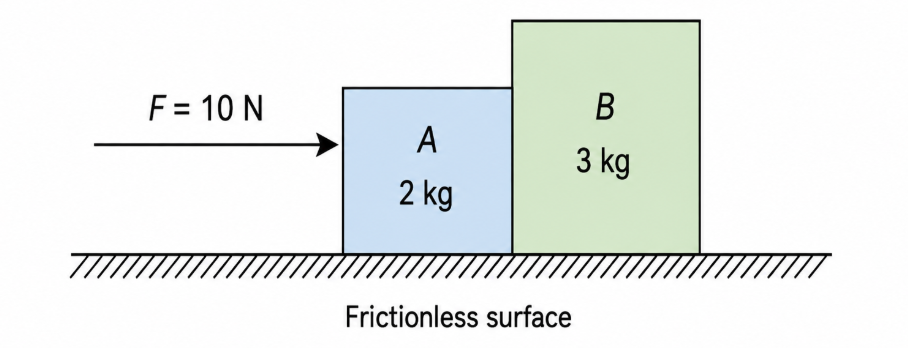
A horizontal force 10 N is applied to a block A as shown in figure. The mass of blocks A and B are 2 kg and 3 kg, respectively. The blocks slide over a frictionless surface. The force exerted by block A on block B is:
2024
A
zero
B
4 N
C
6 N
D
10 N
✅ Show Answer
✔ Correct Answer:
C
(6 N)
💡 Explanation
The total mass of the two blocks is 5 kg. Their common acceleration is a = F/(mA + mB) = 10/5 = 2 m/s². The force exerted by A on B is the force required to accelerate block B, so F_AB = mB a = 3 × 2 = 6 N.
🎯 Conclusion
Therefore, the force exerted by block A on block B is 6 N.
2
🧠 Concept
Newton’s Laws and Friction
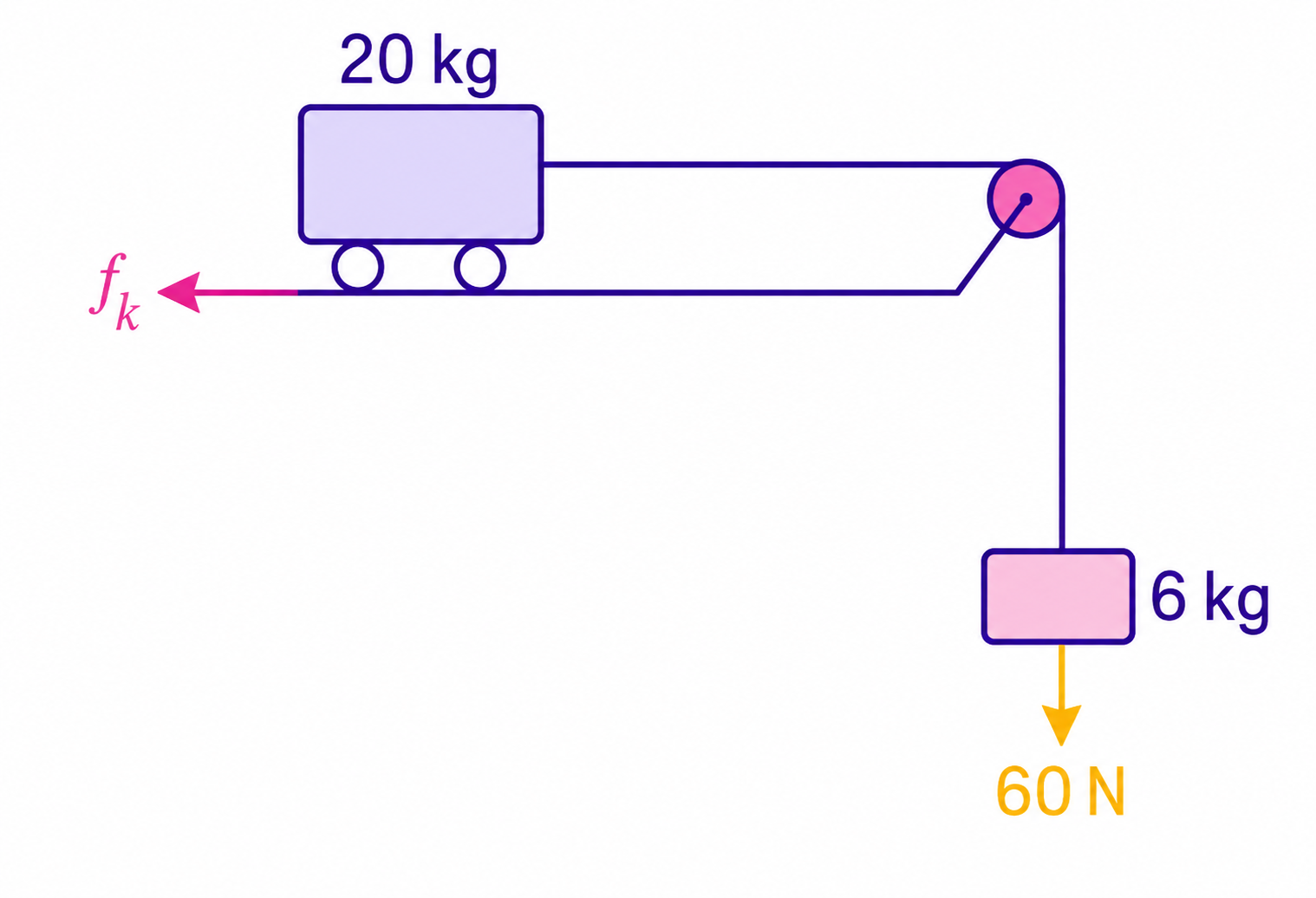
Consider a block and trolley system as shown in the figure. If the coefficient of kinetic friction between the trolley and the surface is 0.04, the acceleration of the system in m/s² is: (Consider that the string is massless and unstretchable and the pulley is also massless and frictionless.)
2024
A
3
B
4
C
2
D
1.2
✅ Show Answer
✔ Correct Answer:
C
(2)
💡 Explanation
The frictional force on the 20 kg trolley is fₖ = μₖMg = 0.04 × 20 × 10 = 8 N. For the complete system, the net driving force is 60 − 8 = 52 N and the total mass is 20 + 6 = 26 kg. Therefore, a = 52/26 = 2 m/s².
🎯 Conclusion
Therefore, the acceleration of the system is 2 m/s².
3
🧠 Concept
Friction on Inclined Plane
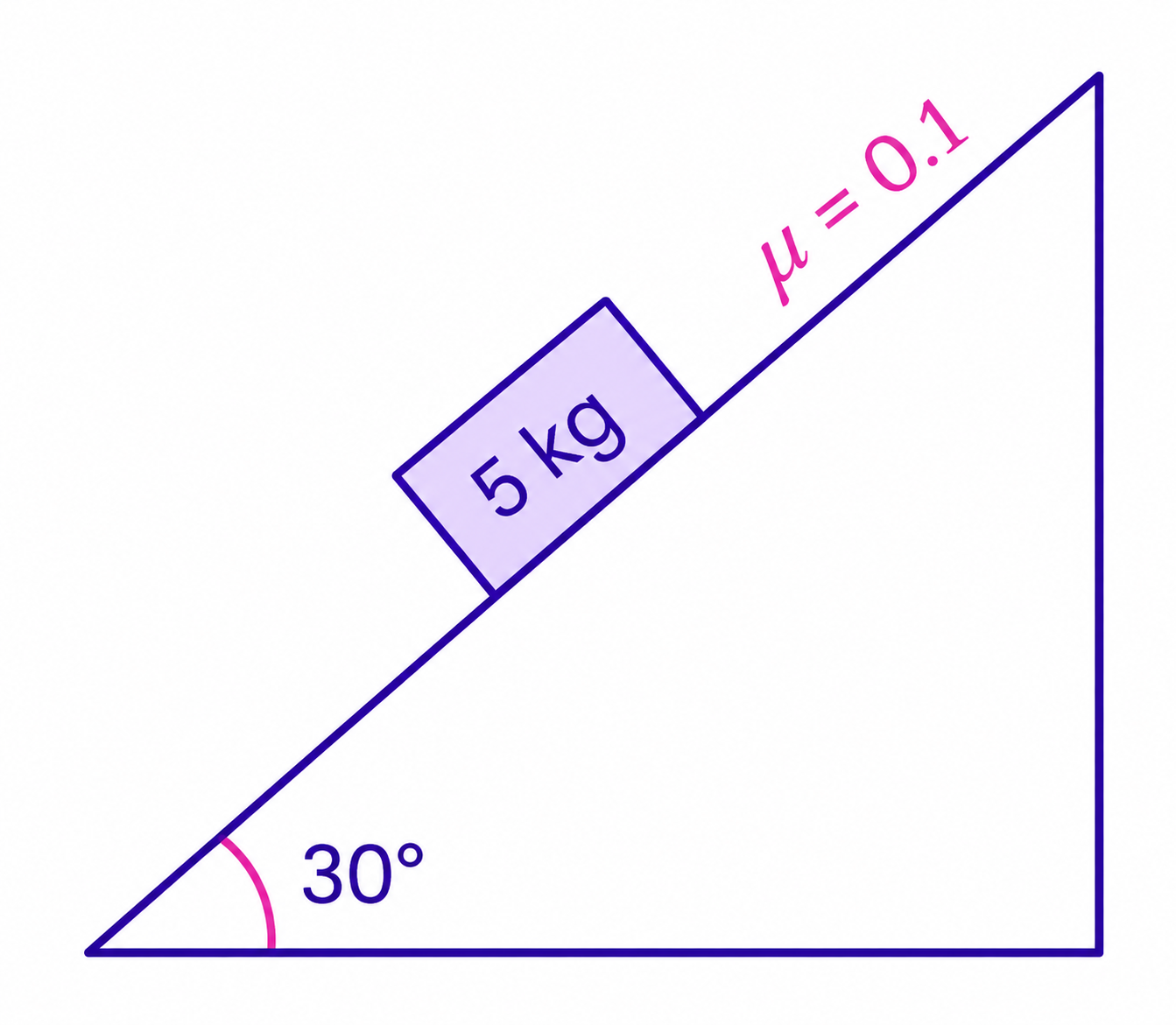
A block of mass 5 kg is placed on a rough inclined surface as shown in the figure. If F₁ is the force required to just move the block up the inclined plane and F₂ is the force required to just prevent the block from sliding down, then the value of |F₁| − |F₂| is: [Use g = 10 m/s²]
2024
A
5√3 N
B
5√3/2 N
C
50√3 N
D
10 N
✅ Show Answer
✔ Correct Answer:
A
(5√3 N)
💡 Explanation
For upward motion, F₁ = mg sin30° + μmg cos30° = 25 + 5√3/2 N. To just prevent downward sliding, F₂ = mg sin30° − μmg cos30° = 25 − 5√3/2 N. Hence, |F₁| − |F₂| = 5√3 N.
🎯 Conclusion
The calculated answer is 5√3 N.
4
🧠 Concept
Impulse and Momentum
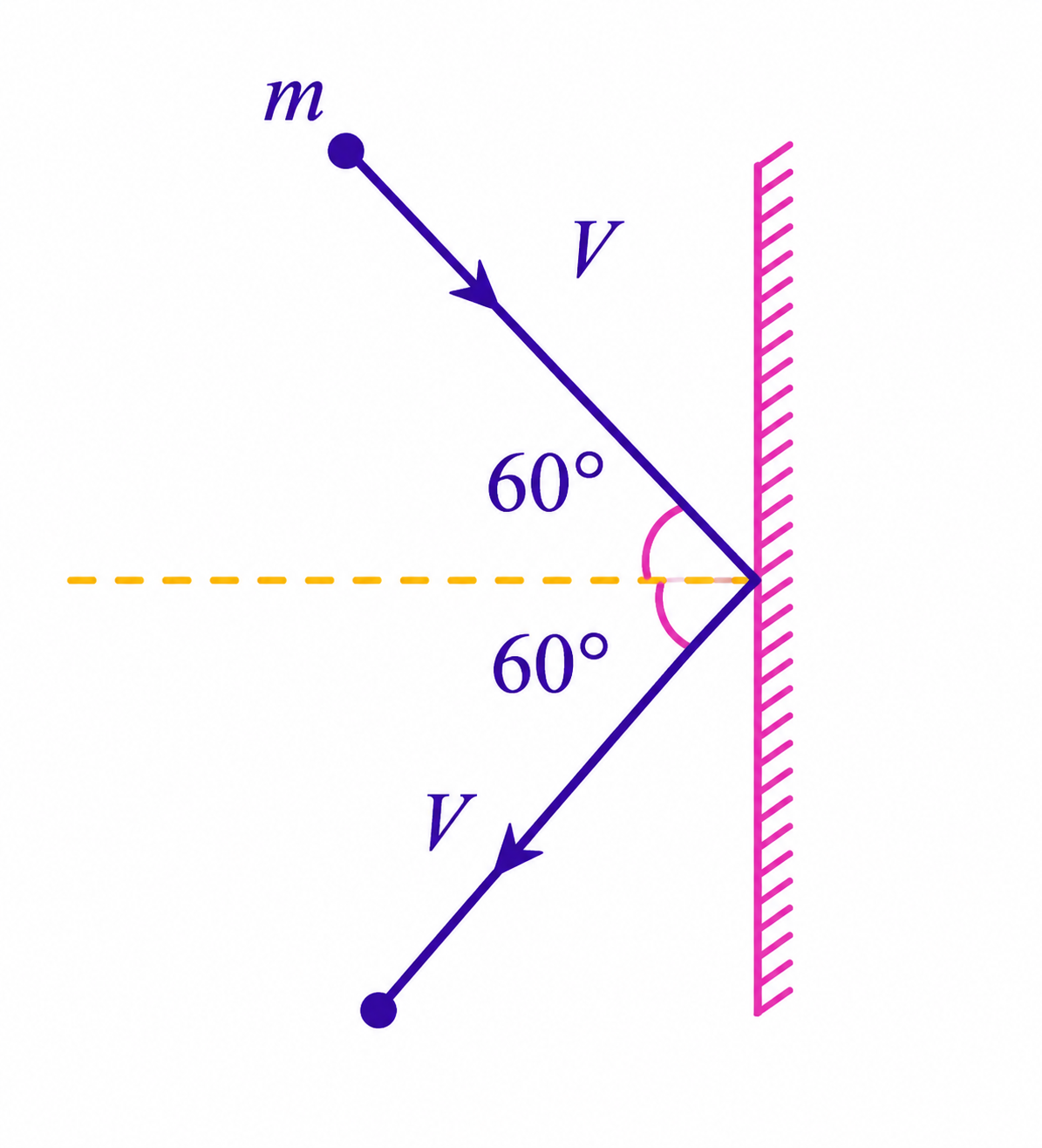
A rigid ball of mass m strikes a rigid wall at 60° and gets reflected without loss of speed as shown in the figure. The value of impulse imparted by the wall on the ball will be:
2016
A
mV
B
2mV
C
mV/2
D
mV/3
✅ Show Answer
✔ Correct Answer:
A
(mV)
💡 Explanation
Only the component of velocity normal to the wall changes during the collision. The normal component is V cos 60° = V/2. It reverses after reflection, so the change in momentum is m(V/2) − (−mV/2) = mV.
🎯 Conclusion
Therefore, the impulse imparted by the wall on the ball is mV.
5
🧠 Concept
Impulse and Momentum
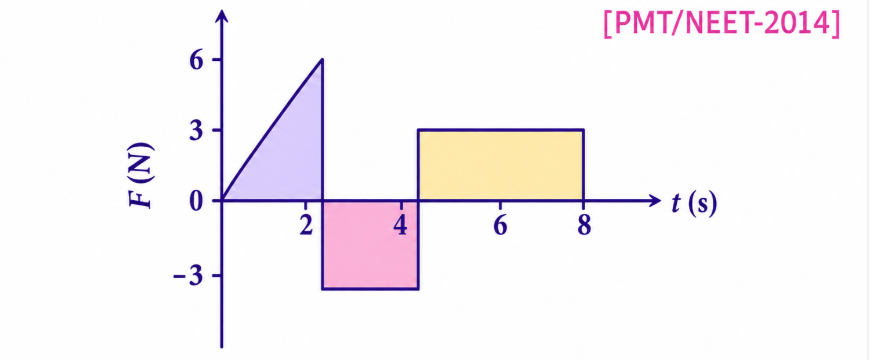
The force F acting on a particle of mass m is indicated by the force-time graph as shown. The change in momentum of the particle over the time interval from zero to 8 s is:
2014
A
24 N s
B
20 N s
C
12 N s
D
6 N s
✅ Show Answer
✔ Correct Answer:
C
(12 N s)
💡 Explanation
The change in momentum is equal to the impulse, which is the area under the force-time graph. From 0 to 2 s, the triangular area is (1/2) × 2 × 6 = 6 N s. From 2 to 4 s, the area is −3 × 2 = −6 N s. From 4 to 8 s, the area is 3 × 4 = 12 N s. Therefore, the net impulse is 6 − 6 + 12 = 12 N s.
🎯 Conclusion
Therefore, the change in momentum of the particle is 12 N s.
6
🧠 Concept
Momentum and Kinematics
A stone is dropped from a height h. It hits the ground with a certain momentum P. If the same stone is dropped from a height 100% more than the previous height, the momentum when it hits the ground will change by:
2012
A
68%
B
41%
C
200%
D
100%
✅ Show Answer
✔ Correct Answer:
A
(68%)
💡 Explanation
For a stone dropped from height h, velocity on reaching the ground is v = √(2gh). Momentum P = mv, so P is proportional to √h. A 100% increase in height means the new height is 2h. Therefore, the new momentum is P′ = P√2. Percentage change = (√2 − 1) × 100 ≈ 41%.
🎯 Conclusion
Therefore, the momentum increases by approximately 41%.
7
🧠 Concept
Impulse and Momentum
A body of mass M hits normally a rigid wall with velocity V and bounces back with the same velocity. The impulse experienced by the body is:
2011
A
MV
B
1.5 MV
C
2 MV
D
zero
✅ Show Answer
✔ Correct Answer:
C
(2 MV)
💡 Explanation
The initial momentum is MV and the final momentum is −MV because the body bounces back with the same velocity. Therefore, the change in momentum is Δp = −MV − MV = −2MV. The magnitude of impulse is 2MV.
🎯 Conclusion
Therefore, the impulse experienced by the body is 2MV.
8
🧠 Concept
Newton’s Second Law
A force of 6 N acts on a body at rest and of mass 1 kg. During this time, the body attains a velocity of 30 m/s. The time for which the force acts on the body is:
1997
A
7 seconds
B
5 seconds
C
10 seconds
D
8 seconds
✅ Show Answer
✔ Correct Answer:
B
(5 seconds)
💡 Explanation
Using F = ma, the acceleration is a = 6/1 = 6 m/s². Since the body starts from rest, v = u + at. Therefore, 30 = 0 + 6t, giving t = 5 seconds.
🎯 Conclusion
Therefore, the force acts on the body for 5 seconds.
9
🧠 Concept
Newton’s Second Law
A 10 N force is applied on a body to produce in it an acceleration of 1 m/s². The mass of the body is:
1996
A
15 kg
B
20 kg
C
10 kg
D
5 kg
✅ Show Answer
✔ Correct Answer:
C
(10 kg)
💡 Explanation
According to Newton’s second law, F = ma. Therefore, m = F/a = 10/1 = 10 kg.
🎯 Conclusion
Therefore, the mass of the body is 10 kg.
10
🧠 Concept
Newton’s Second Law
A force vector applied on a mass is represented as F = 6î − 8ĵ + 10k̂ and accelerates with 1 m/s². What will be the mass of the body?
1996
A
10 kg
B
20 kg
C
10√2 kg
D
2√10 kg
✅ Show Answer
✔ Correct Answer:
D
(2√10 kg)
💡 Explanation
The magnitude of the force is |F| = √(6² + (−8)² + 10²) = √200 = 10√2 N. Using F = ma, the mass is m = F/a = 10√2/1 = 10√2 kg.
🎯 Conclusion
Therefore, the mass of the body is 10√2 kg.